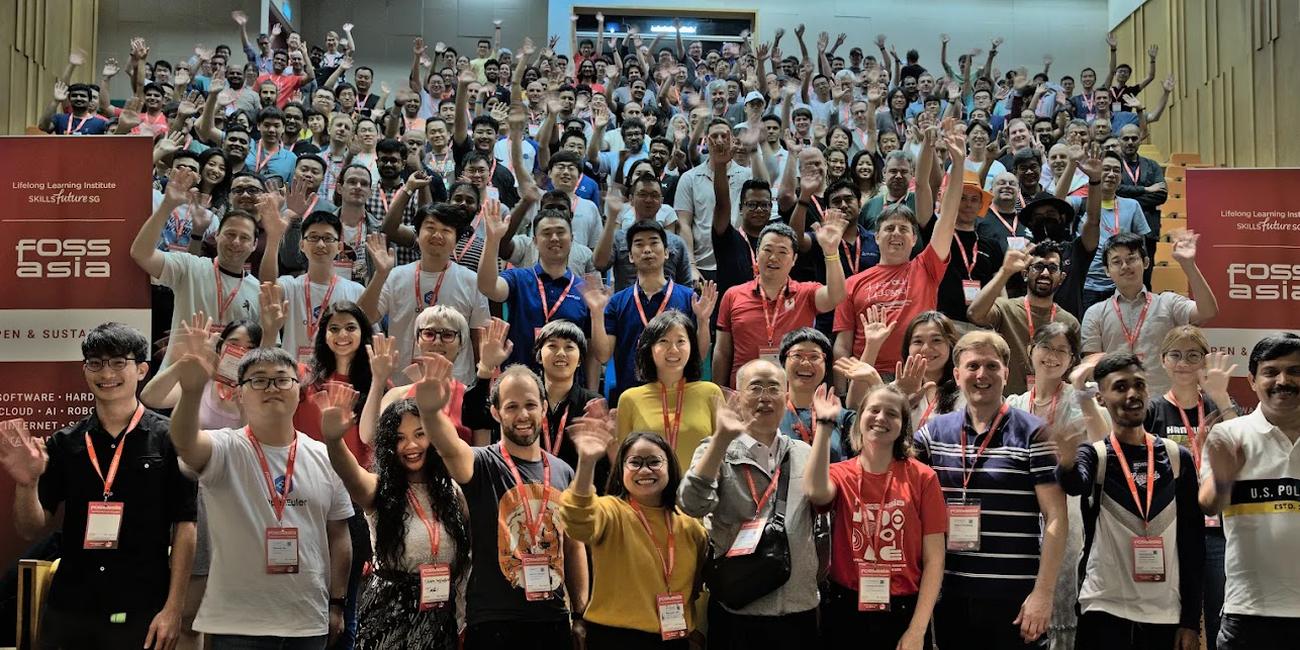
We did it, after two years of Corona we are finally able to meet in person for the FOSSASIA Summit 2023!
Founded in 2009, FOSSASIA has developed a wide-range of open source projects from software to hardware, organized developer events and run coding programs. We want to provide access to open technologies and knowledge that enable people to build solutions according to their own ideas and needs. It is our mission to foster the free and open source movement in Asia and sustain the FOSS ecosystem.
The FOSSASIA Summit has been an annual event that brings together developers, contributors, and enthusiasts from all over Asia and beyond. It's a place where we can share our knowledge, collaborate on projects, and create something truly amazing.
The theme for this year's summit is "Open Tech for a Sustainable World" which is more important than ever before. Climate change is a real threat that affects us all, and it's time for us to come together and find sustainable solutions. Open technology is one way we can help address this issue, by enabling us to create and share sustainable solutions that benefit everyone.
How open source empowers the robotics world: The Robotics Middleware Framework in Singapore
We will take you through our journey to improve Search results relevance in the biggest C2C e-commerce marketplace in Japan through the application of Machine Learning (i.e.: Learning-to-Rank).
This talk will focus on the machine learning side of this journey (with a separate one focusing on the MLOps part). In particular, we will discuss the following topics:
Short introduction to search using ElasticSearch and the idea of reranking
Data acquisition, cleanup, preparation and labeling
Development of model
Our learnings and key takeaways
During all the steps, we have used open source tools for the development and deployment.
Open source software has become a fundamental tool for developers in today's fast-paced technology landscape. However, it's not just about using open source software for development. In this talk, we will explore how open source software can be leveraged to educate, engage, and empower developers.
We'll start by examining how open source software can be used to create innovative learning opportunities for developers of all levels. This can include interactive tutorials, gamified challenges, and other engaging learning experiences that help developers sharpen their skills and stay current with the latest technologies.
Next, we'll discuss how open source software can be used to build inclusive communities that welcome developers from all backgrounds and skill levels. Open source communities can be leveraged to create mentorship opportunities, networking events, and other resources that help developers connect with each other and advance their careers.
Finally, we'll explore how open source software can be used to empower developers to make a positive impact on the world. We'll discuss how open source tools can be used to develop applications that address social and environmental issues, and how developers can contribute to open source projects that have a tangible impact.
Whether you're an experienced developer or just starting out, this talk will offer you a fresh perspective on the potential of open source software and how it can be used to educate, engage, and empower developers.
openEuler is an open source, free Linux distribution platform. The platform provides an open community for global developers to build an open, diversified, and architecture-inclusive software ecosystem. openEuler is also an innovative platform that encourages everyone to propose new ideas, explore new approaches, and practice new solutions.
Code; Without Barriers is a Microsoft's initiative aimed to create awareness, challenge assumptions and celebrate diversity in the world of tech. The program provides a platform to enable female developers, coders, and other technical talent to contribute towards inclusive economic growth, encourage innovation and better reflect the societal makeup of their region
A general presentation to talk about the happenings in the past few months in the MySQL ecosystem and highlight trends/developments of note.
Several years of pandemic spread influenced every branch. Document collaboration is no exception in this case. Lots of teams face certain difficulties: some users want to stay in home office and work remotely despite it’s now possible to get back to real office. Therefore, lots of groups became even more distributed.
To ensure effective teamwork in the current conditions, it’s important to choose right software tools. In our presentation:
1) We’ll present an open-source project ONLYOFFICE and all the novelties over the year since the last edition of FOSSASIA Summit.
2) We’ll tell you how to organize efficient and secure document collaboration within your open-source platform.
3) We'll show you how to make document processing even more productive with plugins, including some popular open-source tools, such as Jitsi, ChatGPT, etc.
With foundry opensourcing PDKs (process design kits) for their older technology and the recent progress of FOSS toolchains, it's becoming easier for everyone to build custom silicon, at scale just like software. Let's look together at the recent progress and actual silicon results of this new thriving open source ecosystem.
In recent years, many open-source-based startups are coming from China, such as M5Stack(Hardware) and PingCap/TiDB(software).
I`m an official member of KaiYuanShe(China Open Source Alliance), Leading some document translation. And my company Switch Science is an Open-Hardware distributer; I also have success with some marketing projects in Japan with Shenzhen Hardware company.
I will introduce some cases of Business development about hardware and software.
Let's take the event group photo together!
Today, AI, heterogeneous computing and diversified computing power are fundamentally changing our IT systems and infrastructure. And some fundamental changes have happened, like CentOS has stopped updating. There are numerous brand new challenges but opportunities for the OS. We will discuss some fresh concepts and brand-new technologies brought by openEuler, a new system that solves those projects in a new way.
This is a dynamic discussion featuring industry leaders and experts in technology. The panel aims to provide valuable insights and guidance to individuals who are interested in pursuing a career in the tech industry, as well as those who are looking to advance their careers. The panelists will share their experiences and perspectives on the various roles and opportunities available in the tech industry. They will also discuss the current trends and demands in the industry, and the skills and knowledge required to succeed in these roles.
The discussion will focus on how individuals can prepare themselves for the industry needs, including education and training, professional development, networking, and staying up-to-date with the latest trends and technologies. The panelists will also provide advice on how to navigate the job market, including job search strategies, resume writing, and interview techniques.
Attendees will have the opportunity to ask questions and engage with the panelists, gaining valuable insights and actionable advice on how to pursue a successful career in the tech industry. Whether you're a recent graduate, a mid-career professional, or someone looking to make a career change, this panel will provide you with the tools and knowledge to succeed in the exciting and ever-changing world of technology.
Grafana Labs supports a lot projects and communities; some under our own umbrella, some under other umbrellas like CNCF.
With projects like Grafana (51,000 GitHub stars), Prometheus (44.300), and Loki(17,000), we're talking some of the largest projects of their kind on Earth. We will walk through the underlying strategy and the scaffolding of how these successful projects have thrived alongside their healthy and self-sustaining communities.
While it may not be obvious from the outside, all of them follow the same basic outline, adapted to what the different projects need. This strategy is rooted in over twenty years of experience building communities. A large part of this experience was drawn from running the OpenProjects / freenode IRC network, again the largest of its kind, where everything from KDE to Ubuntu to Twitter to Reddit to Bitcoin and Wikipedia was started, and observing what worked for them, what didn't work, and how those communities evolved over time. Another large part of experience was drawn from running FOSDEM, the largest Open Source conference of its type on Earth.
Tea and Coffee Break
Artificial Intelligence and Data Engineering skills are the essentials for every company who wants to gain in this digital age. How to start? Where to begin? How do we know we are going in the right direction? These are genuine questions that will freeze any decision maker. This session hopes to offer a good and tangible way for companies to start to grow their AI & Data talent pool.
In the last year we saw the rise of AI systems like ChatGPT, Stable Diffusion, Dall-E and others. Large Language Models like GPT are enabling a lot of new innovative features and products which will revolutionise the world.
But this large autoregressive language models come with a lot of challenges that can have negative effects on the Open Source and Open Tech community. For example it’s unclear if in the future everyone will have access to the same ML models and training data. Can students, startups and open source people build innovative new products using AI in the same way the open source communities build Open Code and Open Tech. How can we make sure that the AI system are not discriminating underrepresented minorities? What is the energy consumption and CO2 emissions of this new big AI systems?
This talk will discuss the current fascinating trends in AI, the challenges and some possible solution around Ethical AI
The rise of open-RTL cores such as RISC-V promises greater transparency than ever into the internal functioning of a CPU. But how exactly can one take advantage of this?
In this talk, I demonstrate the utility of an open-RTL RISC-V by debugging our Rust-based OS, Xous, using a system-level simulation called Verilator. With this technique, we can access internal state that would normally be very difficult to see through software-only means, such as transitions between kernel and usemode, page table faults and cache misses. The technique could also have great utility in assessing mitigations to Spectre-like sidechannels.
This presentation provides a brief introduction of Bitcoin Ordinals – what they are and how they function, especially how Ordinals are used to provide non-fungibility attribute and on-chain inscription ability similar to that of non-fungible token (NFT) of Ethereum Virtual Machine (EVM)-compatible blockchains.
You will learn about the theory behind these new digital artifacts and the various projects that have sprung up in the space.
The talk will introduce SADO protocol – a self-authenticating decentralized (interplanetary) trading orderbook protocol, designed by us at Birthday Research, the R&D arm of Cake DeFi.
The talk will also cover the tools that we have developed to make development around Ordinals saner and catch a glimpse of what is to come of this newly created Bitcoin inscription ecosystem.
As various sectors undergo digital transformation and the use of digital records accelerates accordingly, it is more important than ever to ensure the authenticity and integrity of trusted data. Enter OpenAttestation, an open-source framework build on the blockchain that supports the issuance and verification of tamper-proof documents.
This talk will introduce the benefits of OpenAttestation and explain how it works. We will cover products built using OpenAttestation (such as OpenCerts, HealthCerts and TradeTrust) and demonstrate its features such as the OpenAttestationMerkleProofSignature2018 proof method.
Attendees of this talk will gain a deeper understanding of how OpenAttestation can be applied to simplify the endorsement and verification of documents. They will also be equipped with the knowledge and tools to start implementing OpenAttestation in their own industry.
New expectations are coming with the every year and 2023 sees a lot of new technology trends and a strong focus on cost-saving. Questions include:
- What technologies will become relevant
- What jobs will be in high demand
- And what practices will emerge or take hold.
Hands-on experience with technologies such as Apache Kafka, Cadence, Rubik, Varnish, Transtats, FluxCD become increasingly important. The ability to deploy to Kubernetes is essential and skills to effectively manage networking, security, user access, maintenance, performance and scale.
One of the biggest trends coming is in DevOps practices. DevOps aims to replace error-prone and manual procedures managed at the interface between development and operations teams with more robust automation. Incorporating the DevOps framework is vital for company growth because it improves overall work efficiency.
GitHub Actions is a powerful tool that allows developers to automate and streamline their workflow. With GitHub Actions, you can build, test, and deploy your code directly from GitHub, saving time and effort in the development process. Whether you're working on a small personal project or a large enterprise application, GitHub Actions can help you automate tasks such as building and testing code, deploying to production, and more. With a wide range of integrations and a simple yet powerful syntax, GitHub Actions is an essential tool for any developer looking to improve their workflow and efficiency.
Last year, GovTech began a journey to improve engineering collaboration and code sharing across the government through the use of internal open source practices - we'll cover the challenges, lessons learned, and peek into what the future holds!
In this session, the outcomes of a small project will be summarized that aimed to find out what kinds of scaling models made sense for distributed manufacturing in the Global South. While DM has been celebrated for its smallness, it has a lot of potentials in resource scarce environments, but also to empower local communities and to manufacture products that are really needed, close to the end-user, and sustainably. The talk will focus on challenges and enablers of scaling DM, and present the scaling models we’ve found.
MySQL is still hot, with Percona XtraDB Cluster (PXC) and MariaDB Server. Welcome back post-pandemic to see what is on offer in the current ecosystem.
Did you know that Amazon RDS now uses semi-sync replication rather than DRBD for multi-AZ deployments? Did you know that Galera Cluster for MySQL 8 is much more efficient with CLONE SST rather than using the xtrabackup method for SST? Did you know that Percona Server continues to extend MyRocks? Did you know that MariaDB Server has more Oracle syntax compatibility? This and more will be covered in the session, while short and quick, should leave you wandering to discover new features for production.
Come for an unbiased walk through the servers and what they offer from a feature standpoint.
The rapid rise in Big Data use cases over the last decade has been accelerated by popular massively scalable open-source technologies such as Apache Cassandra® for storage, Apache Kafka® for streaming, and OpenSearch® for search. Now there’s a new member of the peloton, Uber's Cadence for code-based scalable fault-tolerant workflow orchestration. To illustrate the most important Cadence concepts (and more) we’ll build a realistic drone delivery service demonstration application, and discover how fault-tolerant workflows scale using event-sourcing and the Cassandra database (supplemented with Kafka and OpenSearch for enhanced visibility). We’ll also explore what happens when orchestration meets choreography, and use the drone application to illustrate different ways to integrate Cadence with Apache Kafka, including starting workflows from Kafka, coordinating workflows with Kafka, and reusing Kafka microservices. But how scalable is Cadence in practice? To find out, we’ll fill the sky with drones – how many drones can we get flying at once?
Industrial Control Systems and Operational Technology (ICS/OT) are critical components of modern industrial infrastructure, and their security is essential to ensure safe and reliable operations. However, the current threat landscape is increasingly hostile, with cyber attackers targeting ICS/OT systems for financial gain, espionage, or sabotage. Moreover, ICS/OT organizations face unique challenges securing their environments, such as legacy systems, complex interdependencies, and limited visibility.
This presentation will discuss how an Applied Defense-in-Depth strategy using Free and Open-Source Software (FOSS) can help ICS/OT organizations secure their critical infrastructure. The talk will cover five key takeaways:
1. Understanding the current threat landscape for ICS/OT cybersecurity, including recent attacks and emerging threats.
2. Identifying the challenges that ICS/OT organizations face in securing their environments, such as limited resources and expertise and complex networks.
3. Introducing the Defense-in-Depth concept and how it can be applied to ICS/OT cybersecurity.
4. Demonstrating practical FOSS solutions for implementing Defense-in-Depth in ICS/OT environments, such as network segmentation, intrusion detection, and secure configuration management.
5. Highlighting the benefits and limitations of FOSS in ICS/OT security, such as interoperability, customization, and support.
TARGET AUDIENCES
• C-Suites and executives who oversee ICS/OT systems and are responsible for their security
• Directors and managers of IT and cybersecurity who are responsible for securing ICS/OT systems
• Leaders in the ICS/OT industry who are interested in learning about the latest trends and strategies for securing critical infrastructure
• Technical experts in ICS/OT cybersecurity, including security engineers, operators, and analysts, who are responsible for implementing and managing security solutions in ICS/OT environments
TOPIC OUTLINE (45min)
I. Introduction
A. Overview of ICS/OT cybersecurity and the current threat landscape
B. Challenges facing ICS/OT organizations in securing their environments
C. Purpose of the presentation: to introduce Applied Defense-in-Depth with FOSS as a practical solution
II. Defense-in-Depth for ICS/OT
A. Definition and principles of Defense-in-Depth
B. Importance of applying Defense-in-Depth in ICS/OT environments
C. Real-world examples of successful Defense-in-Depth implementations
III. FOSS Solutions for Applied Defense-in-Depth
A. Overview of FOSS and its benefits and limitations in ICS/OT security
B. Technical solutions for implementing Defense-in-Depth with FOSS, such as network segmentation, intrusion detection, and secure configuration management
C. Business-level considerations for implementing FOSS-based solutions, such as interoperability, customization, and support
IV. Case Studies
A. Examples of ICS/OT organizations that have successfully implemented Applied Defense-in-Depth with FOSS
B. Lessons learned and best practices from these case studies
V. Conclusion and Key Takeaways
A. Summary of the presentation
B. Key takeaways for technical and business-level attendees
C. Call to action for attendees to apply Applied Defense-in-Depth with FOSS in their organizations
Processors are at the heart of our devices. As they become more integrated with other functions, what do we know about they work? Do we trust their designers? We present a computer design with a FPGA RISC-V processor implementation, allowing for the underlying hardware to be inspected.
Description:
Increasingly, what we call the processor on our computers and phones is actually a System on Chip (SoC) - that is to say, the processor is coupled with other elements such as integrated graphics, connectivity (ie PCIe) or other management functions. What do we really know about the hardware underlying modern computers?
Vulnerabilities found in subsystems such as those in the firmware of the Intel Management Engine (ME) found in most modern computers reveal a blunt truth - we have to trust, blindly or begrudgingly, that our chips are correctly implemented and without any backdoors, intentional or otherwise.
In this presentation, we take a look at how the hardware manufacturing ecosystem impacts the security of the devices we use. We also present a computer design whose processor is implemented in a FPGA (Field Programmable Gate Array) based on the open source RISC-V Instruction Set Architecture (ISA), as well as the toolkits available for synthesizing digital hardware.
Today's landscape mandate for the IT to have the ability of its system to restore on an alternate cluster when the primary cluster fail. This disaster tolerance is conceptually an implementation of replication and failover from primary to alternate location, which the alternate location is typically located far away from the primary location. Through data replication, the secondary cluster will have an up-to-date data that are committed on the primary cluster. If the primary cluster fails, the secondary cluster will take over.
Due to long distance where network bandwidth and latency typically not suitable for a stretch out cluster. Thus, in MySQL, stretching InnoDB Cluster across two site is generally unfavourable due to performance and stability. Instead of using InnoDB Cluster, using InnoDB ClusterSet is a better option.
This talk will share about:
1. What is InnoDB Cluster and InnoDB ClusterSet
2. InnoDB ClusterSet architecture
3. Scenarios with InnoDB ClusterSet
CPU reservation is high in data centers, however usage is lower than predicted (30% according to the research). Containerization and colocation are two techniques for increasing CPU utilization. Nonetheless, this may cause interference between workloads. Rubik is a new solution created by the openEuler community. Its primary goal is to improve CPU utilization while ensuring QoS, particularly for critical online services. Rubik has open-sourced many critical features in openEuler, which is already being deployed in production by Huawei Cloud and Sina Weibo.
P4 (programming protocol-independent packet processors) is a special language to define how the network packet forwarding process is built independently from the underlying hardware. It can be used to dynamically reconfigure the forwarding process on the different target hardware, such as ASIC, FPGA, or SmartNIC. Users can write complete networking programs that includes in-band telemetry/measurement, traffic load-balancing, anti-DDoS, packet broker, and offload protocols. The program can be tested using widely available network emulator, called Mininet, so that the behavior of packet forwarding can be verified before it is deployed in the real target hardware. In this presentation, we will quickly go through on how the P4 program looks like, how to compile, and how it is verified using Mininet emulator software.
The Fido2 is a protocol that uses public key cryptography and biometric authentication to improve security and user experience. It works by using an authenticator and a relying party to verify the identity of the user. Fido2 has many advantages over traditional password-based authentication, such as increased security and improved user experience. This session will provide a comprehensive overview of Fido2, how it works, the current state of Fido2 adoption and its potential for growth & future developments. The session will also provide valuable insights for organizations looking to enhance their security and user experience of their authentication processes.
The open source community is vulnerable to new kinds of attacks on the software supply chain and there have been efforts by many to address those challenges, including across Asia. These efforts urgently require new processes, tools and initiatives to drive adoption.
Heightened interest, by governments and companies worldwide, has seen the open source community respond with a mobilisation plan to achieve specific goals. The Linux Foundation and OpenSSF delivered a first-of-its-kind plan to broadly address open source and software supply chain security, outlining approximately US$150m of funding over two years to rapidly advance solutions to the ten major problems facing open source software security.
These concrete steps are designed to produce immediate improvements and build strong foundations for a more secure future. Find out what is happening around these initiatives in Asia and what you can do to be more secure and support this global security effort.
More and more open source software (OSS) tools are available for FPGA developments. This short talk will present them and compare their performance to manufacture, e.g Xilinx ISE and Vivado. With the popularity gained by FPGAs for Deep Learning, these tools will likely improve significantly with FPGA community efforts and realisation by manufacturers of the benefits of OSS.
Although initially was only for Stateless application, with the birth of StatefulSets in Kubernetes, persisting and migrating data to Kubernetes are no longer a problem because persistent volumes make it possible to run stateful workloads, such as databases, in Kubernetes. By running databases on Kubernetes, you get all the benefits of Kubernetes for databases including security, elasticity, robustness, and automation that benefits your microservice applications.
NDB Cluster is MySQL Cluster based on in-memory NDB storage engine that guarantee extreme performance and high availability for robust and high performance application which suitable the cloud native goal and narrative.
This talk is to explain how to deploy and run MySQL NDB Cluster using NDB Kubernetes Operator.
1. Why NDB Cluster on Kubernetes
2. Architecture of NDB Cluster on Kubernetes
3. Installation and operation of NDB Kubernetes Operator
Running Operations is not an easy job, especially these days. Ops teams have to ensure excellent user experiences, resolve incidents quickly and help developers stay productive. Yet at the same time, there is also the need to maintain systems security and keep downtime to a minimum.
While advances in cloud computing have helped address some of these challenges, many organizations find it difficult to leverage the cloud at scale because of bottlenecks that form around repetitive tasks, such as developers having to wait for provisioning infrastructure. Despite having access to abundant cloud resources, these speedbumps often make it difficult to achieve team objectives.
Join this talk to learn:
- How to safely delegate the management of your cloud deployment (to developers and other end users) with self-service operations.
- How to create powerful runbooks with guardrails that leverage existing scripting languages, infrastructure, and tools to remove bottlenecks that form around repetitive tasks.
- Strategies for getting started with self-service.
Can Julia-lang also solve the 2-language problem in embedded systems? Can we have a high-performance, high-level programming language which has the low-level control required for an embedded system? I'll share my experience with using Julia-lang in production on embedded devices.
Diving into how CalyxOS implemented configurable device security levels to provide users options to secure their device's security further akin to Tor Browser. Covering the ideas of the team, this session aims to share the development process, the project's output, and plans on how other projects based upon AOSP can implement this feature within their OS.
CalyxOS is an Android mobile operating system that puts privacy and security into the hands of users. Plus, proactive security recommendations and automatic updates take the guesswork out of keeping your personal data personal.
MySQL has long been the number one open source database in terms of adoption. Its high-performance, stable, and highly available architecture has always been the most preferred open source databases for OLTP applications. As Oracle continues to invest, many interesting new features have appeared in few latest MySQL releases, some of them are not well known to most MySQL users, which include GIS features. This session will introduce you to the GIS data types and GIS features in MySQL version 8.0, and how to apply them to MySQL applications. I will use a simple application to show you how to use MySQL GIS to add spatial awareness to a typical OLTP application. After attending this session, you can learn how to use MySQL's GIS features to extend a typical MySQL application into a system that can respond accordingly to users based on the location.
Let's talk about how and when to build a scalable cloud architecture or why it is beneficial to optimize cloud scalability. From a security and a reliability view point to automation, scalable cloud computing has many advantages. In this session we look at the different decisive points.
13 years after the introduction of the RISC-V architecture, it is now ready to take off. This talk will provide a set of answers to many questions that those in the tech (and non-tech) industry could be asking about but did not know how to.
This is meant to be a beginner level session to introduce some of the crucial design decisions done by the inventors of RISC-V and why those matter to the average consumer of technology.
TL;DR: In this tutorial, you will learn how to create, connect and operate three Kubernetes clusters in different regions: North America, Europe and South East Asia.
One interesting challenge with Kubernetes is deploying workloads across several regions.
While you can technically have a cluster with several nodes located in different regions, this is generally regarded as something you should avoid due to the extra latency.
Another popular alternative is to deploy a cluster for each region and find a way to orchestrate them.
In this session, Daniele will demo live:
How to create three clusters: one in North America, one in Europe and one in South East Asia.
How to create a fourth cluster that will act as an orchestrator for the others using Karmada.
How to create a single network out of the three cluster networks for seamless communication using Istio.
The Gen3 Data Commons [1] is a platform for managing and sharing large-scale genomic and health data sets, created by the National Cancer Institute (NCI), and is released under the Apache Software License 2.0. It provides a standardized way to store and access data, as well as tools for data harmonization and analysis. The Gen3 Data Commons also includes a user-friendly interface for researchers to easily discover and access data sets, and collaborate with others.
We have integrated Gen3 with High Performance Computing (HPC) to assist users in conducting high-speed computing at National Center for High-Performance Computing, Taiwan (NCHC) [2]. Our team refined the cloud deployment procedure that was provided by the original Gen3 team, and also adopted it into NCHC cloud service successfully. We also provide a light weight deployment solution under docker compose environment to help scientists or developers to evaluate Gen3 [3-6]. Through the data protection and sharing technology of Gen3, the HPC cluster can also access data and perform analysis. The relevant integration includes Private k8s, authentication integration, storage, computing, and more.
This is a presentation to share and explain how we use Gen3 and continuously integrate it into NCHC's services, to assist researchers in related fields with data analysis through high-speed computing resources, especially for users who need to conduct large-scale data analysis projects.
Reference
1. https://gen3.org/
2. https://www.nchc.org.tw
3. https://github.com/ceasar-sun/nchc.gen3-docker-compose
4. https://github.com/Thomas-Tsai/cdis-manifest-nchc
5. https://github.com/Thomas-Tsai/ng3-manifestservice
6. https://github.com/Thomas-Tsai/ng3-cloud-automation
YDB is an open-source distributed horizontally-scalable fault-tolerant database built from scratch. Its key characteristics include:
strict consistency with a possibility to relax guarantees for better performance;
horizontal scalability;
geo-replication for availability;
support for high-performance multi-row and multi-table ACID OLTP transactions;
support for row based tables
support for column based tables
support for embedded streams
support for declarative query language YQL (a dialect of SQL).
YDB is used as a mission-critical database for many Internet-scale services.
YDB has been designed as a platform for various data storage and processing systems and aimed at solving a wide range of problems.
In this talk, We'll introduce 4 open communities from Korea: Cloud Bandwagon, C++ Korea, Ubuntu Korea Community and Women Who Code Seoul. We will discuss the history, goals, and activities of each community, as well as their contributions to the open-source and tech community in Korea. We will also highlight some of the challenges and opportunities facing these communities, and discuss how they are working to overcome them.
Join the showcase sessions!
Now that we're at our next long term release in 10.11 its time we sat down and relish in the very delicious database changes of MariaDB, by MariaDB and community developers. A UUID Type salad, some GRANT TO PUBLIC eels, System Versioned tables with modification bread rolls. There are some of the very new and delicious things added to MariaDB since its last (10.6) long term support release in 2021. But what else I hear you ask? There's some meaty InnoDB fast loading improvements, more JSON fruity platters, UCA 14.0, MASTER_DEMOTE pâté, and a bit of InnoDB memory politeness in a flan.
If you are struggling in your journey to reach a fully DevOps organization, this talk is for you.
We will review how to scope an application showcase/initiative to share key results to your Senior Management in order to fully support your DevOps transformation.
We will review the 4 main pillars of DevOps: Continuous Integration - Continuous Delivery (CICD) pipeline, Infrastructure as Code (IaC), Micro-Services and finally the Agile methodology.
All profiles are welcome: from business owner to developers, operations or cybersecurity engineers.
The combination of AI, Web3, and FOSS has the potential to play a crucial role in achieving the United Nations' Sustainable Development Goals (SDGs). AI could be used to make better decisions and manage resources more efficiently for sustainable development, while Web3 and FOSS provide the transparency, accountability, and accessibility needed for sustainable growth. Moreover, the open-source nature of FOSS enables collaboration and knowledge-sharing across borders, creating opportunities for communities to work together towards a common goal. In this presentation, we will explore how these technologies can be leveraged to drive progress towards the SDGs, addressing issues such as climate change, poverty, and inequality.
I would also like to take the opportunity to introduce our Open-Source ESG Management product currently named,'Envixi' which is helping organisations to build sustainable businesses by enabling to measure,manage and communicate ESG performance seamlessly.
I aim to inspire more members of our FOSS community to get involved in the project to maintain its competitiveness with proprietary solutions and ensure that technology is accessible to businesses looking to make a positive impact on the world.
The planned technical workshop event will focus on Zephyr RTOS, a small, scalable, and secure real-time operating system for use on resource-constrained devices. The event will discuss how Zephyr can be used to accelerate the development of AI and IoT applications, as well as the support for RISC-V architecture. Attendees will have the opportunity to see a live demonstration of Zephyr running on an FPGA using a soft-core RISC-V implementation.
Decentralized finance was a shot for anyone and everyone to be involved in finance. However, in attempts to create communities around different products and pushing out innovative concepts, many projects have ended up isolating themselves from the masses.
Gone are the days of simple products that just work and are easy to understand. Instead the space is filled with enigmatic products that requires a 70 pager documentation and 50 different ELI5 tweet threads to explain them.
In this talk, I'll share how we can do better as an industry, drawing on lessons learnt from building a decentralized fixed income product that just works at Bluejay.
HTTP-based APIs have become indispensable for the inner workings of the modern-day Internet. Not only are APIs a foundational element of the mobile-first world we live in, but they are also the glue between all the components in a microservice architecture. But, when you’ve suddenly got a surge of traffic, can you ensure your APIs are always available with acceptable response times, especially at large scale? We’ve seen that even the biggest organizations often find themselves unprepared – and the results can be catastrophic.
There’s a simple – yet powerful – solution and it’s entirely open-source: accelerate your APIs by caching them with Varnish Cache, the world’s most advanced open-source cache solution that today accelerates over 10 million of the world’s top websites. Virtually every developer has heard of Varnish Cache, but few know it can be used to accelerate APIs and offload workloads on the edge. This presentation will cover leveraging the power of HTTP's built-in caching mechanisms in Varnish Cache as well as use cases to implement intelligent caching and API acceleration at the edge with Varnish Cache's built-in VCL programming language.
Attendees will learn how to use Varnish Configuration Language (VCL) to influence caching decisions, connect to various backends, offload authentication, perform rate limiting and throttling, and even create a personalized caching experience by modifying API output on the edge.
Organizations have been struggling to discover valuable insights in their massive data lake with machine learning because of the lack of data scientists and knowledge. Machine Learning is one of the most wanted capabilities on organizations’ transformation roadmap to be able to use machine learning to predict outcomes for critical decision-making for the business.
MySQL HeatWave Automated Machine Learning (AutoML) is designed to enable you to explore and discover hidden insights with Automated Machine Learning technology.
In this session, you will learn about
· What you can do with HeatWave AutoML?
· How to use HeatWave AutoML?
· Rationalize prediction results with HeatWave's explaner function
We created a service that:
- Allows users to generate AI Art in Telegram Messenger similar to Midjourney on Discord.
- Provides a Telegram Web App for advanced features.
- Accepts cryptocurrencies as payment to access Premium features.
- Allows users to mint their generated images into NFTs.
There are many more Raspberry Pi use cases, although we are still under COVID-19 environments and semiconductor shortages. So, what is a good case for you? Masafumi is helping Raspberry Pi use and business in Asian areas and collaborating with many Raspberry Pi equipment vendors. He will talk about several use cases using Raspberry Pi in Hobby DIY, Education, and Enterprise Business in detail and discuss the lesson from those use cases with you.
Guaranteeing reliability, that is, guaranteeing correctness and completeness even in the presence of failure, is difficult and intimidating. This talk will discuss a blueprint for a principled failure handling strategy. Using a systems modeling approach, we will accurately and concisely describe forward recovery and backward recovery, application-level and platform-level failures, as well as transient, intermittent, and permanent failures. You'll gain an an actionable and comprehensive understanding of how to implement the ideal failure handling strategies for your applications with confidence.
This talk covers,
- Overview of MySQL-8 architecture and its structures: What's new? Data dictionary, system tables, temporary and undo tablespaces, encryption, Redo and Binary logs, tools, and Utilities.
- Add-ons in Percona server for MySQL-8
- Major default changes and their impact on upgrade from the old version, with some examples cases for changes related to the storage engine, authentication plugin, character set, etc.
- Top configuration setting to optimize for scaling database performance.
- Scaling read-write workload with Traditional Replication, Group Replication, InnoDB Cluster, PXC.
Sometimes while adopting the InnerSource the teams might struggle with unclear communication, constant uncertainty and strong feeling that “Your InnerSource is Not Working!” ™
The talk observes the most popular mistakes while adopting the practice. Dmitrii will share the pains and learnings met while his journey to the InnerSource that actually works and brings the value to the business together with making the engineers happier. Each way contains practices and tools that help the team avoid friction and do the process better and faster. Definitely good to watch before you decide to start your own journey.
In this tutorial session we showcase our recent work to leverage Jupyter Notebooks and Conda packages to publish and share interactive experiments using open source silicon toolchains.Notebooks published at https://github.com/chipsalliance/silicon-notebooks demonstrate how to run experiments from design to gds using publicly-hosted notebooks without having to install any tool locally. Additionally we show how those notebooks can be scaled on a public cloud provider to explore the parameters space of various silicon designs:
- We deploy an opensource terraform solution https://github.com/proppy/rad-lab to provision jupyter notebooks with all the necessary tools pre-installed to model our experiments w/ design and flow parameters.
- Between each batch of experiments we report estimated performance metrics to a blackbox and hyperparameter optimization service (which has also an opensource implementation https://github.com/google/vizier) allowing it to suggest new parameters for future batches.
- We observe that the experiments quickly converge toward the best metrics for the given designs.
- Each of the jobs result in a standalone notebook allowing us to share, aggregate and reproduce every experiments.
Future is Open - we have all heard this. Let us examine how FOSS technologies can be used at all levels to build variety of solutions. In this session we will walk though multiple distributed technologies (kubernetes, kafka, distributed sql, etc.) to build a solid production grade tech-stack for our applications.
For those of us who already know how important open source is, it can be challenging to persuasively make the case to management, because we assume that everyone already knows the basics. This can work against us, confusing our audience and making us come across as condescending or concerned about irrelevant lofty philosophical points.
In this talk, we take it back to the basics. What does management actually need to know about open source, why it matters, and how to make decisions about consuming open source, contributing to open source, and open sourcing company code?
We will check out and have a journey on the story of OceanBase, an enterprise grade open-source distributed database, starting with how the decision went from internal use case for Alibaba, Ant Group, from commercialization across to open source platform to contribute to the open source community and collaboration with Open Source developers globally.
Are you tired of working in silos and dealing with inefficient workflows that hinder innovation? Join us as we explore the power of InnerSource and how it can transform your organization's software development process. From breaking down silos to using goal question metrics and the plan-do-check-act cycle, we'll delve into practical strategies that can boost collaboration, increase efficiencies, and ultimately drive better outcomes for your customers. Plus, we'll showcase the power of data visualization tools like Grimoire Labs, which can help you track progress, identify areas for improvement, and build a thriving InnerSource community. Don't miss out on this opportunity to learn from InnerSource experts and take your software development to the next level!
"Test sets" have long been available for testing communications equipment during manufacture and maintenance, optimised for broadcasting and telco equipment rather than amateur equipment.
Amateur requirements are extremely varied, but for HF ionospheric communication in particular are uniform enough that ARRL Labs has been performing standardised evaluations for their published equipment reviews for decades. Fortunately ARRL has also published their detailed test procedures, however performing them as written requires racks full of costly test equipment.
Homebrew testing does not require the same level of precision as testing for published reviews does, so a mid-range SDR and a handful of common RF workbench items (attenuators, switches, precision oscillator, ...) is enough to perform almost all of ARRL's tests. HATS is:
- an SDR-based hardware test fixture adequate to perform most of ARRL's tests without any re-cabling between tests; and
- a suite of scripts to perform those tests.
We present a performing method of Alter Table in MariaDB. This method can help ensure that alters are performed quickly and smoothly, without causing lag in the replicas. We will provide best practices for implementing lag-free alters in MariaDB
Datadog Observability Pipelines is gaining popularity as a DevOps / SRE technology for hybrid cloud data observability. Based on a vibrant open-source community-supported project called Vector (https://vector.dev), Observability Pipelines are leveraged by companies with resilient, flexible data observability pipeline use cases in both cloud-native and on-premises environments.
This talk provides an overview of the Vector technology, as well as the various DevOps and SRE use cases which are easily implemented using Vector.
It is a win-win situation if these big tech companies know how to contribute upstream, and Open Source projects can work with this new blood to tackle common tech problems. Willem will share the story of engaging with big tech companies in China through the Apache Local Community. By holding ApacheCon Asia and mentoring podling projects for years, we (Apache Local Communities in China) build good connections with the OSPOs of big tech companies in China.
In this talk, I will be explaining what DevTestOps is and how testing is made continuous in various stages of SDLC. I will also explain how Gitlab handles quality engineering and how testing is baked into the product at various stages. This thereby enhances product quality and enables the team to adhere to testing and quality specific best practices.
Open source firmware allows for greater transparency and collaboration
in the development process, which can lead to more reliable and secure firmware.
In addition, open source firmware can be freely modified and customized to meet
the specific needs of an organization or user, which can be particularly useful
in a server environment where the firmware may need to be tailored to the
specific hardware and software configurations of the server. In short, open
Source firmware is smaller, faster, more secure and more flexible than the
closed sourced software it replaces.
This talk will give a introduction into the open source firmware projects out
there that target the x86 architecture, what devices they support, how to get
them and how to install open source firmware onto them.
We will provide a short introduction to the concept of open source
firmware and its role in controlling the basic functions of devices. We will
discuss some of the popular open source firmware projects, such as coreboot,
U-Boot, and TianoCore, the types of Intel x86 devices that they are used on, and
where to get them.
The talk will also showcase innovative projects in the firmware space like
System Transparency, that have been made possible with open source firmware,
highlighting the benefits and potential of this approach. Through this talk,
attendees will gain a better understanding of the role of open source firmware
in modern device development and the ways in which it can enable more flexible
and adaptable solutions.
Container with Kubernetes is hot topic. The session will cover the latest MySQL Operator for Kubernetes to Run MySQL Innodb Cluster with HA capability and automated Backup operation. Running Cloud Apps on Kubernetes with MySQL Operator via the in-built MySQL Router services is simple. Come and join us to uncover the MySQL deployment.
In this engaging 25-minute talk, we delve into the world of large language models (LLMs) specifically designed for source code. We highlight the importance of open-source models for safeguarding privacy, and provide a comprehensive overview of the current state of the art in LLMs.
We then introduce SantaCoder, an open-source LLM for code generation, and demonstrate how it can be fine-tuned for the downstream task of bug fixing, resulting in the SantaFixer model. Trained on a dataset of single-line Common Vulnerabilities and Exposures (CVE) fixes, SantaFixer can generate bug fixes using code inlining.
But that's not all! We unveil an exciting new open-source tool called AutoFix, which combines static analysis with LLM capabilities to automatically detect and fix software vulnerabilities. We showcase the capabilities of AutoFix in action, highlighting its potential to improve overall code quality.
Best of all, SantaFixer and AutoFix are both released under the Apache license, making them accessible to the wider open-source community. Join us as we explore the cutting-edge world of open-source LLMs and their transformative impact on the future of software development.
In Viettel, our public cloud services are heavily based-on open source projects like OpenStack, Kubernetes, Prometheus,... For the Kubernetes related products, they were built on top of Cluster API that uses OpenStack as an infrastructure provider.
By default, the cluster that was created by Cluster API did not contain some components like ELK/EFK stack, Prometheus,... We can guide our users to manually install these components with some scripts/manifests. However, that manually process can easily introduce lots of issues to our customer.
Therefore, by leveraging the power of FluxCD and its toolkit (Helm Controller), we can provide a better solution for our customers to manage pre-defined kubernetes workloads on these clusters.
In this presentation, we will share:
- Using Cluster API to build a Kubernetes Services for public cloud
- Consideration and gotchas when using Cluster API with OpenStack
- How we can automation and managing workloads on multiple Kubernetes cluster with ease
[1] Cluster API is a Kubernetes sub-project focused on providing declarative APIs and tooling to simplify provisioning, upgrading, and operating multiple Kubernetes clusters.
[2] Flux is a tool for keeping Kubernetes clusters in sync with sources of configuration (like Git repositories), and automating updates to configuration when there is new code to deploy.
Spending years consulting with clients, we have some real world deployment notes of common issues and how we solve them. These are the tips and tricks to get you running in production without any issue.
Have you ever wondered how to configure evs.* setting for Galera Cluster? Have you ever wondered what is the ideal setup for a geo-distributed Galera Cluster with 9-nodes? What about when is the right time to introduce a proxy like ProxySQL or GLB? What are the habits of the most successful developers deploying against Galera Cluster?
Come to this talk to be successful with your Galera Cluster experience, as we distill information from many production deployments.
Silicon chips are common in everyday life, and to many these little plastic packages are opaque mysteries -- their inner workings are close to magic even to those familiar with hardware. Recent advancements in Electronic Design Automation have begun to open this notoriously mysterious corner of design. Open source projects have begun to do for chip design what it has already done for FPGAs, compilers, and operating systems -- bring openness to a field that has been dominated by closed-source players. This talk will discuss what it means for hardware design to be open and what we can do with the tools of today. We'll also cover what is not yet possible, and what we hope to be able to do in the future. As a nice side benefit of the openness of these processes, there will be lots of pretty pictures of silicon designs!
As a part of openshift operator certification QE, we adopted Tekton CI pipeline as our test integration platform, what we found it was easy to manage and more scalable. This helped us in executing our integration TestSuite across all the services in a very streamlined fashion. There are multiple services to tests and many configurations to modify in each stage of the integration tests. This talk is mostly circled around how we integrated different provisioning tools like terraform to provision openshift local like CRC, Ansible as package configuration , Integrating python API/GraphQL tests as well as executing Cypress UI automation tests within the different stages of QE CI pipeline. This talk will provide insights to Devops and QE beginner user on architecting the End-to-End workflow solutions to their QE automation integration test suites.
The RISC-V instruction set architecture (ISA) stimulates the expeditious development of novel hardware platforms. Consequently, the need for an efficient and easy-to-use operating system on RISC-V architecture emerges. However, new challenges such as system building, hardware adaptation, and application ecosystem should be addressed as the hardware podium develops. This talk explores the practice and experience of openKylin, an open-source operating system, on the RISC-V hardware platform to address these issues, including kernel optimization, UKUI (Ultimate Kylin User Interface) package compilation, and application compatibility.
AI is all the range now, but all the courses you attend don’t show how to apply it properly. This workshop aims to equip you with the ideas behind AI, and how to apply them through the field of astronomy and physics. Through this workshop, you will gain knowledge of the underlying mechanisms behind neural networks and how it is applied in Astronomical Object Classification and Gravitational Wave Detection.
This workshop will focus on data science and how it is applicable to businesses. We will focus on data science modules of python such as Numpy and Pandas and will teach them on how to use such modules to read CSV files and other file types, delete/remove or modify data and export it or present it using data visualisation modules such as matplotlib and seaborn.
Graphs are all around us. From railway networks to puzzle states it is clear that they are an integral type of data. However when it comes to machine learning, standard neural networks do not account for structural information which is key when learning on graph-structured data. Graph neural networks circumvent this problem by learning both structural and spatial biases from the input graph. In this workshop, we will be exploring how Graph neural nets work and their different applications!
During NeurIps 2022, Geoffrey Hinton introduced the Forward-Forward algorithm, a new learning procedure that made back-propagation unnecessary and modeled neural networks more like human brains. This talk will be exploring the implementation and the effectiveness of this new algorithm and look at some examples of it being in use.
Traditional steganographic techniques are widespread and easily identified. With the explosion of embedded AI in mainstream applications, let's take a new perspective and explore its implications for the steganographic scene.
BuildingBloCS is a year-long outreach programme aimed at helping spark interest in Computer Science among Secondary schools and JCs in Singapore. Our primary themes have largely centered around Computational Thinking, AI and Web Development, but we have recently also started pushing for Free Open-Source Software too! In our recently held March Conference, we developed an open source gamified portal inspired by CodeCombat, with a battlestyle similar to games like Clash Royale and BattleCats! The game was developed with various technologies, including Vue, Flask, Kubernetes and PostgreSQL, and in this talk, we aim to shed more light on the development process of the application, and how we ultimately deployed it for nearly 70 participants.
Whisper is an automatic speech recognition (ASR) system trained on 680,000 hours of multilingual and multitask supervised data collected from the web and was released in opensource around October, 2022.
In this talk, I will be covering what is the capabilities of Whisper model, and the various features of whisper model. This will serve as an introduction to whisper model.
One of the key things, I want to highlight with this talk, the fine tuning capabilities of Whisper model in any language as whisper support close to 90+ languages with the base model. We have got great results on fine-tuning a Malayalam base whisper model with reported accuracy of a WER of 108% we were able to fine tune to reach a WER of close to 10%(approx 90 percentage accuracy).
This session walks throught the basic of kubernetes and GitHub Container Registry and How to deploy an app from GHCR to kubernetes. The GitHub Container Registry allows you to host and manage your Docker container images in your personal or organisation account on GitHub. While GitHub Containers already gives teams greater traceability of their software supply chain. I'm going to demonstrate a demo with how to deploy from GitHub Container Registry to Kubernetes
ROS Workshop
Full support of multi-master logical replication in pgLogical has gone unsupported for many years. In this talk, we will discuss the work we have done to bring back multi-master replication in a new derivative of pgLogical.
Additionally we discuss how we implement Geo-sharding in support of low latency, cross-region scale-out and data residency use cases. For the latter, we will focus on enhancements we have made to ensure that PII does not cross national or regional borders.
Finally, time permitting, we will show a demonstration of multi-master replication across three continents and two clouds, showcasing low latency for database users across multiple geographies.
Machine learning algorithms' output can be understood and trusted by human users using a set of procedures and techniques known as Explainable Artificial Intelligence (XAI).
Explainable AI is used to describe an AI model and expected impact and potential biases. It contributes to defining model transparency, correctness, fairness, and outcomes in decision-making system supported by AI.
When putting AI models into production, a business must first establish trust and confidence. A company and the Open Source community can develop and adopt a responsible approach to AI development with the aid of Explainable AI.
This session is a brief overview of Open Source and Explainable AI.
In modern development teams, site reliability engineers (SREs) are the glue that holds developer and operations teams.
It is the goal of the SREs to increase the reliability of their services to meet production standards by setting up monitoring, ensuring proper resource allocation, rolling out updates gradually, and anticipating the cost of failures.
As the size of the APIs increase, the need for making them reliable and robust also increases.
In this talk, Navendu will talk about best practices for API design that lean towards reliability. Attendees will learn about:
- Reliability issues in traditional API design.
- How SREs fit in the API development pipeline.
- Modern API development best practices using API gateways.
- How SREs can combine DevOps practices to build more reliable services.
With the rise of NoSQL databases, a number of falsehoods have flourished regarding how to choose a database engine. This talk focuses specifically on Redis and PostgreSQL, and why one might choose one or the other.
At small scales, we can often get by thinking of database servers as black boxes, but as we scale, the internals and architecture become more and more important. This talk focuses on behavior of these systems at scale and under load.
In this presentation you will learn:
- How Redis and PostgreSQL differ architecturally
- How differences in architecture affect scalability and performance
- Cases here Redis is the clear winner
- Cases where PostgreSQL is the clear winner
Additionally, some notes will be offered in terms of where PostgreSQL can improve in to compete with the sorts of workloads that generally favor Redis.
English writing is a critical aspect of communication in today's digital world. However, not everyone has the expertise to write professional, grammatically correct, and error-free texts, leading to low confidence and potential misunderstanding. The advancement of language models, specifically OpenAI's GPT-3, provides a solution to this problem by helping users to write better, more concise, and more persuasive English. In this talk, we will showcase how we built a Chrome extension that leverages the power of GPT-3 to help users write better English by highlighting any text on the web and rephrasing its sentiment.
The chatGPT Chrome extension is an open-source tool that can be used by anyone looking to improve their writing skills. The extension uses OpenAI's GPT-3 API to generate suggestions on how to improve the tone, grammar, and vocabulary of the text. By highlighting any text on the web and rephrasing its sentiment, the tool can help users to write more effectively, with greater clarity and impact.
In this talk, we will walk through the process of building this chatGPT chrome extension, including its architecture, the challenges we faced, and the solutions we implemented. We will also demonstrate how this extension can be used to convert informal writing into a more professional form, and how it can increase the accessibility of English writing.
The audience will learn about the cutting-edge technology behind this extension, how it can be applied to other domains, and how it can be modified to suit their specific needs. Additionally, attendees will get a chance to see a live demo of the extension in action and provide feedback on its functionality and usability.
Key takeaways:
- Understanding the importance of English writing and the challenges faced by many people.
- Overview of OpenAI's GPT-3 and how it can be leveraged for language applications.
- Introduction to the chatGPT Chrome extension and its features.
- Demonstrate the tool's ability to highlight and rephrase text, and show how it can help users improve their writing skills.
- An overview of the open-source code and how developers can contribute to the project.
This talk is suitable for developers, language enthusiasts, and anyone looking to improve their English writing skills. Imagine being able to write an email, a blog post, or even a book with ease and confidence. With the ChatGPT Chrome Extension, you can achieve that and more. It is also relevant for anyone interested in using the power of GPT-3 to build language applications.
Redundancy and high availability are the basis for all production deployments. Database systems with large data sets or high throughput applications can challenge the capacity of a single server like CPU for high query rates or RAM for large working sets. Adding more CPU and RAM for vertical scaling is limited. Systems need horizontal scaling by distributing data across multiple servers. MongoDB supports horizontal scaling through sharding. Each shard consists of a replica set that provides redundancy and high availability. In this session we will talk about:
-How MongoDB HA works
-Replica sets components/deployment typologies
-Cluster components - mongos, config servers and shards/replica set
-Shard keys and chunks
-Hashed vs range based sharding
-Reads vs Writes on sharded cluster
The components of our Kubernetes Cluster ecosystem are built on the OpenStack cloud infrastructure platform. We rely on open source initiatives like Cluster API Provider OpenStack to supply cloud infrastructure for K8s Cluster solutions. Because our cloud architecture is private, while constructing Clusters for that Opensource solution, information about infrastructure resources like LoadBalancer, VPC, etc. will not be visible on the public cloud. This leads to:
- Customers won't be able to update, revise, statistics, estimate expenses, or develop contingency plans in a timely manner since they don't have the information about those resources.
- Additionally, it will take a long time to determine which resource is having a problem when there is an issue with the client's infrastructure, which impacts the customer's experience and the customer will not be satisfied.
Therefore, based on the open source Cluser API Provider OpenStack project integrated with our public cloud, we can offer a better solution to give the customer with resource information so they are able to manage, update, estimate costs for resources, etc., improving the experience of our clients.
[1] Cluster API Provider OpenStack is a Kubernetes sub-project focused on provisioning the infrastructure for multiple Kubernetes clusters.
This presentation will focus on the application of Prompt Engineering in the context of generative image models and large language models. Topics will include how prompts can be designed to effectively leverage the capabilities of these models and how they can be utilised in various use cases such as creative writing, information retrieval and content/code generation. The presentation will also explore the challenges and limitations of using these models for prompt engineering, and how they are being addressed by researchers and practitioners in the field.
Mapping is the process of generating a representation of the environment which a mobile robot can use for autonomous navigation. It typically requires a robot to explore the physical space while running a SLAM algorithm in the background. However there are some inconveniences from this approach. It may be time consuming for very large environments. A bigger challenge is keeping the representation up-to-date with any changes in the physical layout of the space. This talk explores the idea of generating SLAM maps from digital twins of physical environments created using open-source tools such as rmf_traffic_editor, gazebo and navigation2.
Have you wondered how we may nurture values among our students in support of health and well-being? What about how curricula may be designed to develop climate literacy among youth and the leaders of tomorrow? In this session, you will hear the voices of young people themselves, as they share an example of how they have conceptualised, designed, and enacted citizen science investigations inspired by observations from their own respective local environments. Utilising open source hardware whenever possible, the team behind the Life2Well Project does not rely on expensive and fragile industrial-grade equipment which cannot be taken out of the lab. Be inspired by the stories of the students as they share their ups and downs through their investigative journeys, and their hopes as young makers for the future.
CHAMP is an Open Source development framework for building new quadrupedal robots and developing new control algorithms. The control framework is based on "Hierarchical controller for highly dynamic locomotion utilizing pattern modulation and impedance control : implementation on the MIT Cheetah robot".
'DevOps' is dead, and it's probably good news. We may be at a tipping point where the anti-patterns of the DevOps movement, like the DevOps job titles and the DevOps teams, can finally be laid to rest. These common anti-patterns manifest as an excessive amount of meetings, long waiting times, over reliance on a 'talented few', and high team cognitive load.
This talk shares perspectives from real world, on the ground experiences on the common DevOps anti-patterns and their costs to developer experience and productivity. It attempts to explain how we got to this point. Finally, it presents the case of how platform engineering teams, working with the principle of platform as a product, could be the next evolution of the DevOps movement, and help enable a true DevOps culture.
- Converting many forms of data into one is not easy.
- Is there a better way to convert email, spreadsheets, RDB, CSV, JSON, etc. into one data?
- Are you still copying and pasting?
This will cause the same work again when the data is updated.
Besides, you may want to convert only a part of the data.
Let's solve those problems. - Apache Hop is a new open source data orchestration project.
- In this session, I will share its use cases.
- I will also show you some real-world examples so you can start using it today.
We will report on our journey from developing and deploying a machine learning model in the search space for the biggest C2C e-commerce marketplace in Japan. This talk will focus on the MLOps side of this journey (with a separate one focusing on the machine learning part).
In particular, we will discuss the following topics:
Using ML in a “traditional” search infrastructure
Architecture overview
Data engineering
ETLs
Training pipelines
Serving in production
Strict latency requirements
Timeouts and failsafes
Caching
“Productionalization”
Logging
Monitoring
Metrics
A/B testing with ML
Moving from “homegrown” model server to Seldon for model serving
Our learnings and key takeaways
During all the steps, we have used open source tools for the development and deployment.
We will dive into the transformative world of open ed-tech innovation, empowering children and youth to thrive in the midst of today's rapidly changing and unpredictable landscape of VUCA. With more than 13 years of experience, Kidspire Vietnam shares successful case studies and educational practices that leverage open Ed-Tech to inspire underserved children for learning, build their confidence, and expand opportunities for their futures after leaving the orphanages. Let's explore how we can collaborate to build a stronger, more inclusive open tech community for our next generations.
ECS stands for Entity Component System and is a popular software architecture used in videogame programming that brings the composition over inheritance concept to the extreme, fully decoupling objects (Entities) from the data they store (Components) and the functions that execute the logic (Systems). This talk will introduce the ECS paradigm with examples on how it can be used in robotics applications, including Gazebo (C++) for simulation and the RMF Site Editor (Rust) for traffic map generation and rendering.
Apache Kafka has recently been modified to remove the dependency on Apache ZooKeeper™ for meta-data management, using a new protocol called KRaft (“Kafka Raft”, a combination of Kafka topics and the Raft consensus algorithm). In theory, this should make Kafka more scalable, allow for clusters with more partitions, and make Kafka clusters easier to run. In this talk, we present the results of some initial experiments and find out if we can create 1 Million partitions.
INTRODUCTION:
Deploying machine learning models in a production environment can be a challenging task, as it requires a balance between model complexity, scalability, and cost-efficiency. In this talk, we aim to share our experience and expertise in building robust, near-real-time machine learning pipelines that can handle high-volume, high-velocity, and high-variety data streams.
OBJECTIVE:
The main objective of this talk is to provide an in-depth understanding of the technical challenges and best practices involved in building near-real-time machine learning pipelines. We will focus on the following key aspects:
Leveraging a distributed event-streaming platform like Kafka for data streaming in ML systems
Importance of pre-computation feature pipeline in the ML systems
Building a feature store that has 4 key attributes - scalable, highly available, handle bursts of reads/writes per second, schema safe for downstream data stitching
Asynchronous inference service for large request payloads
Implementing cost optimization techniques to build ML infrastructure
LEARNING OUTCOMES:
The participants can expect to learn more about the following during the course of the talk:
The challenges and best practices of deploying machine learning models in a production environment
How to leverage Kafka to build a pre-computation layer for feature generation
Challenges in building a feature store for scale
Managing multiple read/writes into a feature sink for highly available downstream applications
Evaluating different ML API serving open source platforms like Cortex, and Seldon core versus managed services like Amazon Sagemaker
Applying cost optimization techniques - scalable inference at up to 85% lower cost per inference
How to build a queryable data lineage management layer over the inference events
Log inference outcomes like your life depended on it - and monitor events like a hawk
This talk takes a dive into the architecture of MySQL’s InnoDB storage engine. From in memory and on disk structures to the various locking strategies used to provide transactions, this talk aims to let you understand why your queries might be running slower than you’d expect.
Hack Club is worldwide community of high school hackers. We make things. We help one another. We have fun. Transparency is a core value of Hack Club, and code is not the only thing we open source. We've open sourced our finances, workshops, events and more.
In this talk, I'll share how we've been open-sourcing our work - for example, building our own transparent "bank" - and ideas we've been experimenting with recently. We'll explore the importance of creating a generation of open-source-first hackers, the benefits of open-sourcing a nonprofit, the challenges we've faced and lessons we've learnt from them.
Lunch sponsored by YDB. Thank you for your support!
Presenting the newly released MySQL Cookbook 4th edition to help developers and administrators to understand simple to complex recipes.
MySQL Cookbook 4th edition was released this summer. We are the book's authors and will show you how to "cook" MySQL. We will show you a few tasks with different priorities, such as JSON in MySQL for those who need flexibility, modern SQL for analytics, and Group Replication for high availability. We will also show how to write programs using JavaScript and Python languages, X DevAPI, and MySQL Shell. We will touch on some of the exciting features of MySQL Spatial Indexes and Geographical Data, Using a Full-Text Search, and more. We're hoping this talk will interest developers and administrators of MySQL.
I'd like to share my authoring experience e and knowledge about an open-source database product MySQL. I also want to touch on this journey's technical and non-technical aspects giving vision and inspiration to future authors. At the end of the talk, I will give away one printed copy of the MySQL Cookbook 4e to an audience after a trivia question.
Please join us for the group photo!
Open source communities have emerged as one of the most significant methods of software development. The infrastructure supporting the community is equally crucial to the success of the community/project as the quality of the project itself. A robust, effective, and simple-to-use infrastructure system may not only make community/project development more seamless by delivering high-quality codes and attracting more contributors, but it can also dramatically decrease costs and operation staff. In this session, we'd want to highlight our experiences and best practices for building cloud-native infrastructure for the openEuler open source community, which supports over 7.5k developers on a daily basis, as well as our future ambitions. It may be valuable for audiences interested in running their own open source projects/communities.
Opportunities abound for applying A.I. to arts and culture use cases, ranging from the mundane to creative expressions. I will share some unique features and challenges of dealing with art data and demonstrate results from our experiment with neural search to make art more accessible. At the end of the session, participants will have a glimpse of how they can build their own multimodal search engine and consider the implications of A.I. in diverse areas of life.
Learn how to Utilize the features of PMM which is a free & open source database monitoring and management tool to get insights into your Database performance, discover some prebuilt dashboards that we ship with PMM for MySQL, MongoDB, and PostgreSQL Databases to provide you with great insights into your database performance and your DB host performance.
In this hands-on session you will discover how to utilize PMM for:
1) Monitoring your Databases.
2) Create Alerts for custom metrics, using Grafana's alerting feature to get alerts about your DB status on different communication channels like Slack/Email/Pager Duty, etc.
3) Create backups of your databases using PMM, schedule backups, and restore from backups just through a very simple UI.
4) Get Insights into your query performance using the built-in Query Analytics tool QAN that we ship along with PMM.
Read more about the tool on our official Website: https://www.percona.com/software/database-tools/percona-monitoring-and-management
How can we help Open Source become more Sustainable? One way we are working on that at IEEE SA OPEN is via Standards such as OSSPG, Open Source Software Project Governance. Often at IEEE SA, we focus on Recommended Practices before creating a Set Standard that could accidentally hurt or limit innovation. Also with Individual Standards, we focus on Consensus Building so that Corporate Dominance does not occur. If done well, Diversity is a key element in consensus focused standards that will stand the test of time. We have found those Recommended Practices to be extremely useful to some new funding models that are arising in the Open Source Community such as government and nonprofit foundations. I will review what is happening but much more importantly what WE can make happen. We as a community need to create more of these Recommended Practices. Why would you want to do this? How to do this effectively? What are some tactics and strategies? And, how do you get support to work on this?
Many configuration settings are present in application systems (such as Hadoop, MySQL, and Hive) that affect how well these systems function. To optimize these settings, however, is a difficult operation because there are hundreds of parameters, and the ideal parameters vary depending on the workload. Based on the openEuler operating system, we create the A-Tune automatic parameter tuning system to address these issues. According to the experimental findings, MySQL's performance increases by 30% to 40%.
Dengue endemic has been troubling ASEAN countries for as long as we know. With the diligent data collection in Singapore, we were able to perform data analysis on the situation. I will be presenting on the various AI methods used to perform data analysis on the dengue infection and the weather data; and sharing the results and the surprising discoveries from the data.
From February to March 2023, Creatorsgarten initiative is collaborating with the Thai Programmer Association and the Bangkok Metropolitan Administration to host the "Bangkok Open Source Hackathon". The goal is to bring together open source communities and contributors.
The event, including workshops led by experts from both the public and private sectors in urban problems and technology, followed by a final hackathon, is the first step in launching the "Bangkok Open Source Initiative" to support and promote open source culture in Bangkok and Thailand.
The talk session will reflect on the project and summarize its methodology, outcome, and analysis of the methods for fostering open source culture.
The adoption of open source software is on the rise across all industries, but the definition of what 'open source' means is getting muddier and muddier. In this talk you will get a crash course in the differences and similarities in open source depending on who's funding the project, the different ways you can engage with the types of projects, and how to decide what type of project you want to work on.
Prometheus is the leading open-source metrics monitoring solution. Prometheus 2.x contains a highly optimised Time Series Database (TSDB). It has ACID compliance and works efficiently with 100s of millions of time series on a single node. On top of its code base, Cortex, Thanos, and Mimir have implemented distributed TSDBs.
The Prometheus TSDB has many components that make this all possible - an in-memory database, a Write-Ahead Log (WAL) for durability, memory-mapping of data from disk, persistent immutable data blocks with highly optimised inverted indices, and various techniques of maintaining this data in the background.
This talk will take you through the entire lifecycle of a time series sample `(timestamp int64, value float64)` starting from the point it enters the Prometheus TSDB’s in-memory database until it gets deleted from the persistent blocks according to the retention policies.
sysMaster is a new init daemon that enables unified system service management for macro and micro kernels in containers, virtual machines, physical computers, and edge IoT devices.
The introduction of the 1+1+N flexible architecture and features such as self-healing via savepoint improves init dependability and promotes system stability. Additionally, we've made numerous performance improvements to ensure lower resource use and smoother startup.
sysMaster is now available as an open source project in the openEuler community and will be used by Huawei Cloud.
As a tech/entrepreneur consultant for the last 35 years I've encountered many EduTech companies. So many have a "build it and they will come" attitude and an expectation to replace teachers while they revolutionize education. Yet this has clearly not happened and these companies weren't even widely adopted during COVID when they had their best opportunity for market share.
As the son of two educators and someone who has home schooled my own three boys, I will argue that the premise of most EduTech offerings is fundamentally unsound and offer an alternative perspective. Some aspects of this perspective have already demonstrated success a few times and I will describe how it is being applied to a new effort I am leading that has access to 80% of the Thai Curriculum students in Thailand over the next two years.
Open Source Projects faces various legal challenges.
Broad Legal issues
Best Practices for Open Source Projects
Defensive Patent Strategies for Open Source Projects.
IoT technology is affecting our lives at a rapid pace, and becoming an integral part of daily life. RTOS-powered "Light" Smart tech is considered to be more applicable to fit the requirements of IoT development.
In this session, we'll explore the "Light" Smart tech and how OpenSource RT-Thread Project works to fit this trend. Major topics that we will discuss include:
- The concept of the "Light" Smart tech and how it applies to daily life.
- The requirements for an RTOS for AIoT devices. How OpenSource RT-Thread works to fit this trend.
- The architecture of the RT-Thread Project and the project features and pros.
- Building an open-source ecosystem for developers.
Relational databases such as PGSQL, which have strong query capabilities and provide ACID constraints, are widely adopted by customers, the ability to scale horizontally, ability to provide minimal latency and high availability, ability to provide global distribution, ability to have data consistent across replicas and shards become interesting problems to solve. These are particularly relevant in todays’ data intensive modern planet scale applications. This session will showcase an open source engine namely Citus, which provides distributed SQL / sharding capability for PGSQL. We will discuss the internal architecture, capabilities, and use cases in building multi-tenanted SaaS Apps on Postgres.
Facing various problems of enterprises in the field of open source, we build a knowledge system, systematically share our long-accumulated experience, provide cooperation in terms of team, mechanism and project, promote enterprises to use and contribute to open source more efficiently, and improve the level of open source technology and application across the industry. https://github.com/opensource-rainforest/osr
Toolbox containers provide an excellent way for developers to use different Linux Operating Systems interactively within a single system. It allows a lightweight approach to separating your development environments from your main system, which can be updated independently, while still allowing sharing files and resources directly with the host system.
The two main projects https://github.com/containers/toolbox and https://github.com/89luca89/distrobox/ will be demoed and compared.
API testing is the process of testing APIs to ensure that they are functioning correctly and meeting the required specifications. It is critical for the quality and reliability of software applications.
In the presentation, Barkatul will cover a range of topics related to API testing, including its importance, the different types of API testing, and strategies for writing effective test cases and data mocks. He will also discuss common challenges and problems that can arise during API testing and how to troubleshoot and resolve them. Additionally, he will introduce the audience to Keploy and provide examples of how it can be used to simplify and streamline the API testing process.
Have you visited a non-English website that was obviously not designed/built/reviewed by a native speaker? It doesn't make sense that with only 5% native English speakers globally, the web is 95% English websites. With some tender loving care and CSS, we can build a better non-English web.This talk will go into detail on specific typography-related CSS for ensuring your site's content is presented well in your target locale, strategies when it comes to localisation efforts and some funny anecdotes from my personal experience. There will be a CJK (Chinese, Japanese, Korean) focus but the main goal is to inspire everyone to build a better non-English web.
In recent trends, websites and softwares often focus on visual beauty and fancy UX rather than the basic human rights requirements such as accessibility and security. This session will cover how developers and designers can use progressive enhancement and other measures to ensure their products are accessible and privacy centric. It will also cover means for designers and developers to have better communication so that the designs don't get lost in translation by developers.
With the advent of containers, Kubernetes became the de-facto tool to manage these millions of containers. While IP address is a scarce resource, every last pod in Kubernetes demand its own IP address. From infrastructure design perspective, it presents a challenge. A key aspect of container networking is IP address management, which often gets overlooked. How Kubernetes assigns IP address to pods is determined by the IPAM (IP Address Management) plugin being used. Different IPAM plugins provide different feature sets. This talk throws some light on how some of the open source CNI plugins tackles the challenge of IP exhaustion and approaches IPAM.
Modeling data with versioning enables data teams to track and reproduce history for fast- and slow-changing data over time. In the era of read-optimized cloud data warehouses and ELT (Extract-Load-Transform) workflows, there is still value in integrating dimensional data modeling practices with modern functional approaches in the modern data stack to design efficient and reproducible data models for analytics reporting use cases that require accurate reporting of point-in-time historical dimensions. In this talk, I will be exploring how we can design history-preserving data models and reproducible data transformation workflows by adopting "change-aware" dimensional modeling practices in the modern data stack.
Openmeetings provides video conferencing, instant messaging, white board, collaborative document editing and other groupware tools. It uses API functions of Media Server for Remoting and Streaming Kurento. MS Active Directory is in most enterprises, the de facto authentication system for Windows systems. Openmeetings can be integrated with LDAP & Active Directory to grant domain users privilege to login the system. Furthermore, we can unify AD and Linux to facilitate system login. In this talk, the speaker will illustrate details of how to configure LDAP & ADS with Openmeetings, and discuss RBAC mechanisms about how to unify AD and Linux by authenticating LDAP users to login a Linux client machine. Concepts of AD, such as forest, domain, and Linux modules, such as PAM, SSSD and NSS will be discussed. Classes and functions in code snippets of Apache Openmeetings will be explained. Configuration files will be discussed from a user’s point of view assuming you have basic knowledge of java and LDAP. At the end of speech, demos of development and system configuration will be given.
Ever wondered how does AWS runs the platform itself? How does the AWS DevOps team ensure the internal security? What are the different modes of authentication used by AWS? In this session we will look at the internals of the AWS cloud platform and security.
Purple HATS (https://github.com/GovTechSG/purple-hats) is a customisable, automated web accessibility testing tool that allows software development teams to find and fix accessibility problems to improve persons with disabilities (PWDs) access to digital services.
Learn how the accessibility testing tool was created, the challenges it tackles, and the open-source technologies it is built upon.
Purple HATS is listed in the Digital Public Good (DPG) Registry as a product that helps to achieve Sustainable Development Goals (SDG10) of Reduced Inequalities.
https://app.digitalpublicgoods.net/a/10152
https://www.undp.org/blog/why-singapore-building-digital-public-goods
Purple HATS is built by GovTech’s Accessibility Enabling Team (A11y Team). The A11y Team was set up to ensure the needs of all users, especially the elderly and Persons with Disabilities (PWDs), are considered during the design and development of government digital services.
VLC 4.0 and Beyond: Advancements in Open-Source Media Player Technology
The long awaited 4.0 version of VLC Media Player brings significant enhancements and changes which are still delaying its release. Lots of internal rework have been made and a new UX interface will offer an intuitive and modern design.
We will also review some new player API and platforms, offering a powerful, flexible, and open-source media player, empowering developers to create new and innovative products and services that can better serve the needs of users.
Additionally, future support for WebAssembly will allow easy embedding into web-based applications, providing a seamless media playback experience across different browsers and operating systems.
A complex camera support library for Linux, Android, and ChromeOS
Cameras are complex devices that need heavy hardware image processing operations. Control of the processing is based on advanced algorithms that must run on a programmable processor. This has traditionally been implemented in a dedicated MCU in the camera, but in embedded devices algorithms have been moved to the main CPU to save cost. Blurring the boundary between camera devices and Linux often left the user with no other option than a vendor-specific closed-source solution.
To address this problem the Linux media community is collaborating with the industry to develop a camera stack that is open-source-friendly while still protecting vendor core IP. libcamera was born out of that collaboration and offers modern camera support to Linux-based systems, including traditional Linux distributions, ChromeOS and Android.
An open-source knowledge-based community software. You can use it quickly to build Q&A community for your products, customers, teams, and more.
https://answer.dev/
Have you ever thought about writing code in a tool that doesn't recognize the programming language you're using? Nowadays, we cannot even imagine working on a project with a code editor that doesn't support syntax highlighting, autocompletion, linting, go-to, and hover functionalities. In addition to the increasing speed of programming languages' evolution and the creation of new ones, many code editors and IDEs have also been developed in the last decade. But, all these code editors share a common problem: The problem of integrating code support with the functionalities mentioned above as a sophisticated extension. Technically, someone has to write an extension for each programming language per code editor, repeating the same underlying logic. The Language Server Protocol (LSP) answers this M * N problem: Considering M languages and N editors.
In this talk, we will learn how the Language Server Protocol (LSP) changes this M * N problem into an M + N problem by providing language support services in a decentralized manner. We will explore how a language server contains a deep understanding of a specific language while the LSP provides the communication between the language server and extension in code editors. More importantly, we will learn how to develop a language server efficiently using Ansible Language Server (ALS) as an example, followed by a demo. A vital part of the presentation will be to discuss how this beautiful concept of language server combines with the open-source culture and see how the community has already developed extensions for vim and emacs around the ansible language server. By the end of this talk, you will have a clear understanding of the core concept of a language server and the knowledge necessary to start developing one. You will also have sufficient resources to build an extension or plugin for your favorite code editor based on an existing language server.
There is no prerequisite for you to be able to follow this talk; all you need is a passion for developing programming language tools.
If it comes to a migration to the digital sovereign office productivity family often the technical tasks and the dependencies in cooperation with users are unknown. With the shift to more cloud based collaboration there are new challenges beside the deployment of a desktop based installation. The goal of the talk is to show all relevant LibreOffice technology family members for different devices and mention the technical relevant items which should be covered in migrations. A second often underestimated part of such migrations, the factor human, will be mentioned as well. At the end of the talk there will be a wrap up of all the possibilities to engage in the community in different needs for migrations and how The Document Foundation behind LibreOffice secures the quality of services around development, training and migration consulting in its eco system.
There are several potential benefits of having a shoe-based communicator device that replaces the traditional keyboard.
Here are some possible advantages:
Hands-free communication: With a shoe-based communicator device, users can communicate without having to use their hands. This can be particularly useful in situations where people need to keep their hands free for other tasks, such as when working with their hands or carrying items.
Greater mobility: Since shoes are worn on the feet, a shoe-based communicator device could potentially provide greater mobility than a traditional keyboard. Users could move around freely while still communicating, which could be particularly useful in situations such as sports or outdoor activities.
Discreet communication: A shoe-based communicator device could allow for discreet communication, as users could send messages without others knowing. This could be particularly useful in situations where people need to communicate without drawing attention to themselves, such as in a crowded room or during a meeting.
Accessibility: For people with disabilities that make it difficult to use a traditional keyboard, a shoe-based communicator device could provide a more accessible way to communicate. For example, people with limited hand mobility or dexterity could use their feet to type messages.
Novelty: A shoe-based communicator device could simply be a fun and novel way to communicate. It could appeal to people who enjoy trying new technologies or gadgets, and could become a conversation starter or fashion accessory.
In this talk I will go over 5 core ways of how to do open source design with and within a community. Hopefully this will help you:
- Learn how you can participate in Nextcloud design
- And which techniques to apply within your own project.
It goes from structural involvement, through the design process, research, documentation, as well as collaboration with other projects. All strategies that we successfully implement at Nextcloud and have seen working in other communities as well.
Kubernetes Ingress is one of the most widely used resources across Kubernetes. It helps to expose your applications and services to the outside world. However, the networking landscape in Kubernetes has significantly evolved. Many modern use cases very quickly exposed the limitations of Ingress API. This led to the creation of the Gateway API, a collection of new resources and APIs which improve and will potentially supersede Ingress in the future. What does this mean for you? Join us and learn everything you need to know about what Gateway API brings to the future of Kubernetes networking.
In this talk, we will start with a brief history of finite state automata, exploring some
of the popular modals, focusing primarily on classic Harel state charts.
We will then explore some of the advantages of working with state machines, while observing
some side by side examples of how some constructs can be simplified by using state charts
rather than explicitly caching variables in code.
Finally, we will showcase a new tool which allows application developers to use a graphical
interface for designing state charts for application business logic and demonstrate how
these can be used in your applications.
Sonic Pi is a code-based music creation and performance tool.
In this session, we'll discuss a short introduction to Live Coding Music followed by examples in Sonic Pi.
- Building Blocks - notes and rhythm
- Live Loops - syncing different instruments
- Creating a music track on the fly
When developing technologies that include mobile, start with mobile first.
Developing mobile-first when designing VPN protocols takes into account unique edge cases developers won’t traditionally find on desktop apps. While desktop apps are more reliable, stable, and quick–Android and iOS app developers find themselves needing to take into account other challenging factors in a mobile environment, such as power consumption, performance, and constantly changing networking environments.
Through this session, Pete will share his learnings from developing and integrating VPN clients into different build environments. Using Lightway as a case study (a new, open-source VPN protocol built for the mobile-first world), discover what unique edge cases and issues exist when building and adapting it for 4 million people around the world–quickly, reliably, and most importantly, safely.
This session will also discuss the importance of open-source VPN protocols in the modern day, how creating and releasing Open Source software can bring tangible benefits to businesses, and how to gain traction in creating and supporting an Open Source community.
Let's wrap up the FOSSASIA Summit 2023.