
Welcome to OpenTechSummit India at Devcon! In this short opening, we introduce the day. You'll hear what's happening in the talk track and the workshop room, how the sessions connect, and where to find the FOSSASIA team, mentors and project demos throughout the day. We'll also share practical information: how to join the hands-on workshops, where to try the LED badges and other open hardware, and how to connect with speakers and fellow builders. Whether you're here to learn, to meet people or to make your first contribution, this is where your day starts.
Visdom is back with a major new release.
Over the past years, contributors from the FOSSASIA community and beyond have worked on hundreds of changes across the project. The result is a much more capable Visdom with new ways to track, compare and understand machine-learning experiments, a significantly expanded visualization toolkit, new framework integrations, improved image and embedding workflows, better exports, stronger testing and major improvements across the server and frontend.
In this session, Vedansh will show what is new in Visdom and demonstrate some of the most useful features directly: experiment tracking, experiment search and comparison, hyperparameter analysis, integrations with PyTorch, Lightning, scikit-learn, Keras, XGBoost and Optuna, new visualization types, improved image workflows and many smaller improvements throughout the platform.
The new release is also the result of a growing open-source contributor community. We will look at how the project has developed, what contributors have built together and how regular collaboration is helping Visdom move forward again.
And there is more coming. We are working with developers and researchers on the next set of improvements, expanding support for modern AI workflows and developing Visdom Dev, a hosted platform that will make it possible to use Visdom online without operating your own server.
Visdom 0.3 is available now on GitHub and PyPI. Join the session to see what has changed, try the new features and find out how to get involved in what comes next.
When 2 Seconds Matter: Building Real-Time AI Captions for Live Events
Live events need captions and translations that feel instantaneous, but building real-time AI streaming is very different from processing uploaded audio.
In this talk, I’ll share what I learned building VoxBento, an open source real-time multilingual streaming infrastructure using FastAPI, WebRTC, MediaMTX, and pluggable transcription providers.
I’ll walk through the architecture from live audio ingestion to streaming transcription and caption delivery, and the engineering challenges we encountered along the way. In particular, I’ll cover why we moved from HLS to WHEP to reduce playback handoff latency, how we integrated both cloud and local transcription services, and why naïve chunk-based Whisper inference can cause context and caption consistency problems.
I’ll also discuss practical approaches to handling overloaded transcription pipelines, including bounded queues, dropping stale audio, voice activity detection, and caption aggregation.
The goal is to give attendees a practical look at the tradeoffs involved in building low-latency, extensible AI infrastructure in open source, along with lessons that can be applied to other real-time AI applications.
This talk will share the story how we develop a versatile event platform for tech conferences with a global community in the age of AI. I
The talk focuses on the engineering decisions, failures, and practical lessons learned from making a check-in system work in the real world.
Traditional video calls put everyone into the same virtual room. Loungemesh takes a different approach: people move between spatial video conversations, creating something closer to the spontaneous interactions of a physical hallway.
This talk explores the engineering behind that idea, the problems that appear when video communication becomes spatial, and how Loungemesh integrates with Eventyay to bring informal interaction into online events.
Money is becoming software. Tokenized deposits, digital currencies and tokenized real-world assets are moving from pilots into the financial system, and programmable money lets payments carry their own rules. This raises a big question for the open source community: will the rails for this new financial layer be open, or controlled by a few platforms?
Much of this infrastructure already runs on open source. Enterprise-grade Ethereum clients such as Hyperledger Besu, open token standards like ERC-20 and ERC-3643, and interoperability protocols are being used by banks and institutions experimenting with tokenization worldwide. India has shown with UPI and its wider digital public infrastructure that open, interoperable systems can reach hundreds of millions of people.
Set up Visdom
Most crypto users approve transactions they can’t read. The wallet shows raw data, the user signs anyway, and that’s how funds get drained. The industry’s main fix is to describe every contract so wallets can show it in plain words, but new contracts are deployed every day and descriptions can’t keep up. ERC-8009 (Proxy Clear Signing) takes a different approach: instead of explaining what a contract does, it shows what will happen to your balance. You sign the outcome, such as “I spend at most 100 USDC and receive at least 0.03 ETH”, and an on-chain proxy cancels the transaction if the result is any different. In this talk, Mark Virchenko shows how the open-source standard works, demos it on Trezor and Ledger hardware wallets, and explains how developers and wallet teams can adopt it.
Small open models are increasingly capable of powering AI agents locally, giving developers more control over privacy, cost, and deployment. But most agent demos follow the happy path: tools work correctly, inputs are predictable, and the agent successfully completes the task. Real-world systems are rarely that simple.
What happens when a tool fails, returns unexpected information, or when a task requires multiple steps? More importantly, can a small open model recognize failure, recover intelligently, and avoid confidently producing an incorrect answer?
In this talk, I will explore these questions through a reproducible experiment using AI agents powered by small open models running locally. The agents will be tested across increasingly challenging scenarios, including tool selection, argument generation, multi-step tasks, tool failures, unexpected outputs, and failure recovery.
Rather than evaluating only the final response, we will examine the agent's behavior throughout the task using practical measures such as tool correctness, task completion, recovery rate, step efficiency, and graceful failure.
Attendees will see where small open models perform well, where agent reliability begins to break down, and what developers should consider when moving beyond demos. The experiment, test scenarios, evaluation code, and results will be released openly for others to reproduce and extend.
Observability platforms like DataDog deliver excellent out-of-the-box experience, but at scale their per-host, per-GB, and per-trace pricing can balloon into one of the largest line items in an infrastructure budget. This talk walks through how we replaced DataDog end-to-end with a fully open-source stack — Prometheus for metrics, Loki with Promtail for log aggregation, Jaeger for distributed tracing, and Grafana as the unified visualization and alerting layer — without compromising on the three pillars of observability. I'll cover the real architecture we ran in production: how the pieces fit together, the ingestion and storage trade-offs versus a managed SaaS product, and the migration path from existing DataDog dashboards and alerts. I'll also be candid about where open source falls short of DataDog (correlation across signals, out-of-the-box APM magic, support SLAs) and how we worked around those gaps. Attendees will leave with a practical blueprint for evaluating whether a self-hosted LGTM-style stack makes sense for their org, along with real cost and operational trade-offs from running it at scale.
Every container image you pull carries a risk - hundreds of packages you didn't explicitly ask for, vulnerabilities you'll spend weeks triaging, and no proof of how it was built. What if you could start from a base image that ships with near-zero CVEs, includes only what your application needs to run, and provides cryptographic evidence of its entire build process?
Project Hummingbird [1] is an open source initiative that produces minimal, hardened container images built from Fedora sources. Every image is distroless by design, built in a SLSA Level 3 pipeline (Konflux), ships with a signed SBOM, and is reproducible -- you can rebuild it locally and verify you get the same bytes. The images are free, redistributable.
This talk introduces Project Hummingbird [1] to an audience that cares about container security.
Key Takeaways
You can start using near-zero CVE, distroless container images today
Supply chain trust (SLSA3, SBOMs, signatures) is built into every Hummingbird image by default
The distroless approach doesn't mean giving up usability
Hummingbird images are reproducible: you can independently verify what you're running
This is open source, built from Fedora, and redistributable
[1] https://fedoraproject.org/wiki/Hummingbird
Writing daily progress updates is one of the most skipped habits in open source, yet it's how maintainers and mentors see what you're working on. Scrum Helper is FOSSASIA's open source browser extension that turns your GitHub activity (pull requests, issues and reviews) into a ready-to-send progress report in seconds. In this lightning talk, we show how it works, how FOSSASIA contributors use it to keep projects transparent, and how you can contribute to the extension yourself.
In blockchain, proof of work shows that real effort was done. In your career, open source is your proof of work: a public, verifiable record of how you solve problems, respond to code review and collaborate with others.
That record matters more than ever. AI can now write code and generate pull requests, so what makes a developer worth hiring, promoting or trusting with critical systems? And in Web3, where many teams are distributed and hiring is global, contributions often matter more than a CV.
This panel brings together maintainers, contributors and people who hire engineers to share real stories and practical advice:
What employers look for now: which skills have gained value, and which have lost it.
Standing out: building a visible track record without green-square farming or AI-generated PRs.
Using AI well: making it your advantage rather than a replacement for understanding.
Where open source leads: paths into Web3 and decentralized teams, and growing from contributor to maintainer and leader.
Most first-time contributors never make it past setup. In this workshop, we set up together and then spend the session on real code in Eventyay, FOSSASIA's open source event platform. Conferences use it for ticketing, calls for speakers, schedules and online events.
You'll clone the repository and bring up the full stack with Docker Compose. This runs Django, PostgreSQL, Redis and Celery on your laptop, with sample data and live reload, so your changes show up instantly.
Next, you'll learn to find your way around a real Django + Vue codebase. We'll look at how the containers fit together, where the code behind each page lives, and how to read the logs. Then you'll pick a small issue prepared for this workshop, such as a template, text or UI fix. You'll create a branch, test your change and are ready for your first pull requests.
You'll leave with a working development setup, and a workflow you can reuse. Ready for more?
Bring: A laptop with Docker and Git installed, plus a GitHub account.
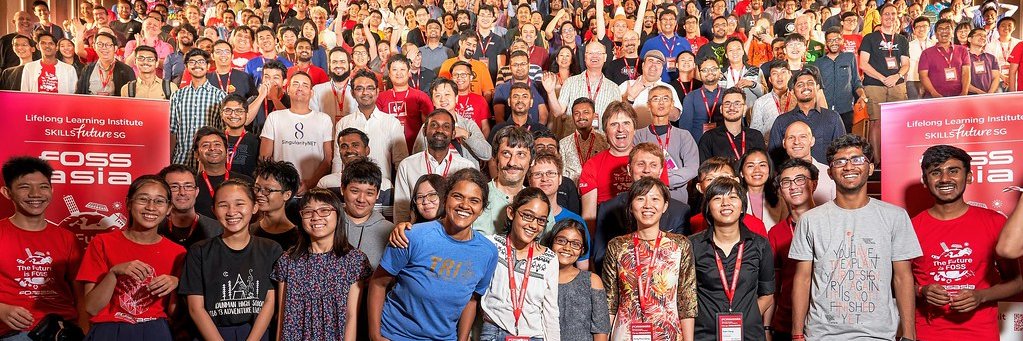
Join us for the OpenTechSummit India community photo! Speakers, contributors, volunteers, partners, and attendees — come together for a quick snapshot of the people making the event happen.
AI can generate code in seconds, but contributing successfully to a real open-source project requires much more than producing a patch.
In this practical session, we will walk through the journey from finding a GitHub issue to getting a pull request ready for review and merge. Using examples from the FOSSASIA eventyay project, we will look at how AI can help developers understand an unfamiliar codebase, trace relevant code paths, explore existing patterns, draft changes and create tests.
The session will also cover the parts that still require engineering judgment: choosing the right issue, verifying the root cause, keeping changes within scope, following project architecture, testing real behavior and responding to maintainer feedback.
The goal is to show that you do not need to understand an entire large codebase before contributing. With the right workflow, AI can significantly reduce the barrier to entry — while the contributor remains responsible for making the change correct, maintainable and useful to the project.
Participants will leave with a concrete workflow they can use to start contributing to FOSSASIA and other open-source projects.
Most first-time contributors never make it past setup. In this workshop, we set up together and then spend the session on real code in Eventyay, FOSSASIA's open source event platform. Conferences use it for ticketing, calls for speakers, schedules and online events.
You'll clone the repository and bring up the full stack with Docker Compose. This runs Django, PostgreSQL, Redis and Celery on your laptop, with sample data and live reload, so your changes show up instantly.
Next, you'll learn to find your way around a real Django + Vue codebase. We'll look at how the containers fit together, where the code behind each page lives, and how to read the logs. Then you'll pick a small issue prepared for this workshop, such as a template, text or UI fix. You'll create a branch, test your change and are ready for your first pull requests.
You'll leave with a working development setup, and a workflow you can reuse. Ready for more?
Bring: A laptop with Docker and Git installed, plus a GitHub account.
Training an AI model can take minutes, hours or days. Waiting until the end to inspect a log file is often too late: loss may already be diverging, gradients may be behaving unexpectedly, validation performance may have stopped improving, or a data pipeline may simply be producing the wrong results.
Visdom provides an open-source way to see what is happening while an experiment is running.
In this session, Norbert Preining will show how Python applications and machine-learning workflows can send live data to Visdom and turn a running experiment into an interactive dashboard. Starting with only a few lines of Python, we will look at streaming loss and accuracy curves, NumPy data, images and model outputs directly into the browser.
The session will then move from individual plots to complete ML workflows: monitoring PyTorch and PyTorch Lightning training, collecting TensorFlow/Keras metrics, organizing experiments, recording hyperparameters and comparing runs. We will also look at how Visdom can be used to inspect images, embeddings and other intermediate results while a model is still training.
A key idea behind Visdom is that visualization should remain separate from the computation itself. Your training framework computes the metrics; Visdom receives, stores and visualizes them. This keeps the integration small, makes Visdom usable with many different frameworks and allows developers to run the visualization server locally, on their own infrastructure or alongside remote training systems.
The latest Visdom work also makes this approach useful for larger experiment workflows: experiments can carry parameters, metrics and tags, runs can be searched and compared, and live results can be explored through hyperparameter and experiment views.
The talk will use short code examples and live visualizations to show how quickly a normal Python or ML training loop can become observable.
Whether you are training a PyTorch model, working with TensorFlow/Keras, exploring NumPy data or building your own AI pipeline, the goal is the same:
don't wait for the experiment to finish to understand what it is doing.
Research workflows often involve a lot of manual work between running an experiment and putting the results into a paper. This project extends Visdom with tools for experiment tracking, publication-quality figure export, LaTeX generation, and comparing experiments. The goal is to make research results easier to organize, reproduce, and use in publications.
Visdom is FOSSASIA's open source dashboard for watching machine learning experiments live, with over 10,000 GitHub stars. Over five months we rebuilt a large part of it in five stages, with 92 pull requests merged upstream
1. Storage abstraction layer: a DataStore interface so every environment save, load, delete and undo goes through one backend instead of raw JSON files.
2. Search layer: an experiment metadata store, an injection-safe query parser, search and field-by-field comparison.
3. Hyper-parameter layer: a dashboard with a run table, scatter matrix, parallel coordinates, a compare view and live updates.
4. Pytest: a suite of nearly 1500+ tests that uncovered real crashes and security bugs.
5. asyncio: disk I/O moved off the event loop and a new AsyncVisdom client, tackling an issue open since 2020 and reaching 2.1x the old client's throughput.
I'll show how each stage made the next one possible, the bugs we found along the way, and why small, reviewable PRs that never break the existing API are what got a mature project to accept this much change.
Writing daily progress updates is one of the most skipped habits in open source, yet it's how maintainers and mentors see what you're working on. Scrum Helper is FOSSASIA's open source browser extension that turns your GitHub activity (pull requests, issues and reviews) into a ready-to-send progress report in seconds. In this lightning talk, we show how it works, how FOSSASIA contributors use it to keep projects transparent, and how you can contribute to the extension yourself.
In this hands-on workshop, explore how to build powerful developer workflows using AGENTS.md, reusable skills, MCP servers, memory, and multi-agent systems. Through live demos, learn how to leverage these capabilities for open-source contributions and Web3 development, building workflows that are reusable, reliable, and safe.
Training loops shouldn't need boilerplate just to see a loss curve. As part of my GSoC 2026 work with FOSSASIA on Visdom, I built VisdomLogger — a native logging API that streams metrics straight to Visdom's live dashboard. It shipped in Visdom v0.3.0 and is already usable today.
VisdomLogger's design keeps Visdom's philosophy intact it receives values through a simple log(name, value) call and never instruments training itself. That boundary is what makes true autologging possible on top of it — and in this talk I'll show the real thing a Keras callback that hooks into model.fit() and streams loss, accuracy, and any tracked metric to Visdom automatically, with zero manual logging calls in the training loop.
In this lightning talk, I'll run a live Keras training script with no logging boilerplate and watch the dashboard populate in real time, then briefly show the same pattern working for PyTorch. I'll close with what's next extending true autologging to PyTorch Lightning, XGBoost, and scikit-learn on a shared backend.
Roger Dingledine co-founded the Tor Project and has spent more than two decades building and maintaining one of the world's most important pieces of open source privacy software. Millions of people use it every day, from journalists and human rights defenders to anyone who wants to browse without being tracked.
In this open session, you set the agenda. Bring your questions about:
how Tor works and where it's heading
what it takes to keep critical open source infrastructure alive for decades
funding and sustaining a nonprofit open source project
privacy and anonymity in a world of AI and surveillance
what the Web3 and open source communities can learn from each other about decentralization
Ever feel like your open-source project is a hidden gem, but no one's picking it up? Maybe it's time to look at the real secret ingredient: developer experience (DX). Good DX is like a good cup of coffee, smooth, energizing, and just the right balance. Bad DX? It's like a broken coffee machine, frustrating and a total mood killer.Developers react the same way when internal tools are brittle, confusing, or slow. They disengage, lose momentum, or walk away.
Lets Dive into how an amazing developer experience can boost your project's contributions, improve your community engagement, and even give your repo a much needed glow-up. We will talk about yay's and nay's of using vibe coding and AI-powered tools. We will also talk about everything from clear, jargon-free docs to efficient, intuitive processes that make contributing feel less like a chore and more like a fun challenge. If you are building in the open, your developers are your users. Let's make their experience exceptional.
Bare-metal provisioning tools speak a language that virtual machines simply don't understand: IPMI and Redfish, the protocols of physical Baseboard Management Controllers (BMCs). Yet in today's cloud-native landscape, there's a very real need to run those same provisioning workflows against virtualized infrastructure: for development, testing, CI pipelines, and beyond.
In this talk, we'll introduce KubeVirtBMC, an open-source, cloud-native project that gives KubeVirt VMs virtual BMCs, exposing IPMI and Redfish endpoints so that existing bare-metal provisioning stacks, whether cloud-native or not (Metal3, Tinkerbell, Foreman, and others), can interact with virtual infrastructure without any modification. Think of it as the Kubernetes-native counterpart to VirtualBMC, but built from the ground up around the Kubernetes controller pattern.
We'll walk through the architecture, demonstrate a live integration with Metal3/Tinkerbell, and discuss project governance, including lessons learned from navigating the migration into the KubeVirt organization.
Let's take a look at the upcoming technology on getting you containers to be.... bootable.
This talk will be a high level overview on what the bootc https://bootc.dev/ is, the main motivations, how it differs from traditional operating systems, and how it is built.
We will look on projects which already employ this technology from the likes of the gaming distro Bazzite and it's base with fedora atomic and how this technology is shaping the linux distro market forward.
By the end of this talk, we will have a demo on getting a bootable container up and running.
Open-source hardware has historically stopped at the circuit board. The primary computer chips we use remain proprietary black boxes, requiring blind trust in massive fabrication factories. This talk introduces an unprecedented partnership between hardware hacker Andrew "bunnie" Huang and Crossbar, Inc., which successfully placed open-source logic alongside commercial Resistive RAM (ReRAM) on a single 22nm chip.
We will break down how this architecture achieves absolute transparency: open-source RISC-V RTL blueprints running the pure-Rust Xous OS, an embedded Memory Management Unit (MMU) for isolated application security, and an innovative physical layout designed for visual attestation (infrared inspection) against factory backdoors. Discover how combining commercial manufacturing with open-source silicon paves the way for truly verifiable, trustless hardware security.
How can a Flutter application interact with an ePaper display, control an LED badge, or visualize real-time scientific measurements?
In this lightning talk, I’ll explore FOSSASIA’s open-source Flutter applications: Magic ePaper, Badge Magic, and PSLab. These projects demonstrate how Flutter can be used to create applications that connect digital experiences with physical hardware.
Magic ePaper allows users to create and transfer designs to ePaper badges using NFC. Badge Magic enables users to create and customize LED badge animations through a mobile or desktop interface. PSLab brings scientific experimentation to connected devices, including real-time signal visualization through an oscilloscope.
I’ll discuss the purpose of these projects, how they have evolved through open-source collaboration, and the technical concepts involved in building Flutter applications for hardware interaction. We’ll also look at the challenges of working with technologies such as NFC, Bluetooth, and device communication.
This talk offers a glimpse into how Flutter and open source come together to build practical, creative hardware-connected applications.
Every 12 seconds, Ethereum produces a new block full of transactions, fees and smart-contract activity. Most people only see this data as a list of hashes on a block explorer. In this hands-on workshop, you will turn it into a live dashboard of your own.
We'll use Visdom and Web3.py to connect to an Ethereum node and stream blockchain data into charts. By the end of the session, each participant will have a working dashboard that updates with every new block, showing:
base fee and priority fee over time
transactions per block
legacy vs. EIP-1559 transaction types
the distribution of ETH transferred
a network overview panel with the latest headline figures
You'll learn how to arrange and save dashboard layouts, and how to set up separate environments for mainnet, testnets or individual contracts. We'll also look at next steps: smart-contract analytics, DeFi and NFT tracking, node health monitoring, and visualizing machine-learning models trained on on-chain data, such as anomaly or bot detection.
No blockchain experience is needed. Basic Python is enough.
What participants bring: A laptop with Python 3 installed, and a free Ethereum RPC endpoint from any provider. It would help to share setup instructions in advance so no workshop time goes to installs.
Platform teams ship LLM features fast. Then production asks a basic question: where did this request go? The answer is rarely one Pod. A chat completion crosses DNS or a Service, often an ingress or gateway, then a model proxy that routes by model name. The serving controller can scale a Pod from zero. The model server loads weights, runs inference, and streams tokens back. Each hop has its own failure mode. A 404 on the wrong API path. A hang while a cold model wakes. A gateway timeout that kills a long stream. Request-count rate limits that ignore token cost. Teams debug the symptom because they never mapped the path.
This talk draws that map. We start from a client call to an OpenAI-compatible endpoint. We follow the request into Kubernetes networking, into the serving proxy, into the Model resource and the Pod that runs Ollama on CPU or vLLM on GPU. We use OpenEverest as a concrete case: an Instance CR declares intent, a provider creates a KubeAI Model, and status writes the phase and endpoint back. The point is the path, not the brand. The same hops appear with KServe or a hand-rolled stack.
This talk will be about Frappe Builder: an open source visual builder anyone can self-host.
I'll open frappe.io, the homepage of a global open source company, and look closely: custom layouts, typography, pages that load almost instantly. It wasn't hand-coded or built on WordPress or Framer. It was made with Frappe Builder. In five minutes, I'll take the site apart to show how it's put together, and why a tool that produces something this distinctive is ready for your production site too.
As AI shifts toward fully autonomous systems, the community faces a critical challenge: breaking down vendor silos. In this quick 10-minute lightning talk, open-source tech founder Steven Mih introduces the Linux Foundation’s Agentic AI Foundation (AAIF). He will map out how the foundational open building blocks—such as Anthropic’s Model Context Protocol (MCP), OpenAI's AGENTS.md, and Block's Goose—are providing developers worldwide with a modular, vendor-neutral blueprint to build multi-agent ecosystems that seamlessly scale.
Large Language Models have revolutionized coding, but forcing AI agents to constantly grep and reread thousands of raw files burns context windows and drives up token costs. Inspired by Andrej Karpathy's vision for the ultimate codebase assistant, Graphify is an open-source tool that instantly transforms an entire repository—code, documentation, and configurations—into a locally queryable knowledge graph.
This lightning talk introduces Graphify's architecture, demonstrating how zero-token, local Abstract Syntax Tree (AST) parsing maps out structural dependencies to serve as a fast semantic context layer for tools like Claude Code and Cursor. Discover how this viral open-source project is replacing legacy codebase indexing and setting the new standard for AI-native developer tooling.
Open inference engines give you many knobs and it’s easy to turn the wrong ones. In this 5-minute lightning talk, I’ll share one concrete lesson from tuning an open-source model server for better real-world performance: what we changed, what metric we watched, and what surprised us.
The goal isn’t a full benchmark suite. It’s a tight takeaway you can reuse when comparing open serving stacks or tuning memory, concurrency, and startup behavior on GPU hosts. Come for one practical lesson; leave with a sharper instinct for which knobs matter first.
AI-assisted software development is increasingly limited not by the model, but by the environment around it. When coding agents fail, the root cause is often missing structure, feedback, and engineering constraints.
This lightning talk introduces Harness Engineering, the practice of designing repositories and workflows that help AI agents work more reliably. Using OpenCode, we’ll explore practical patterns including AGENTS.md, LSP integrations, architectural guardrails, and reusable Skills for encoding team knowledge directly into the development workflow.
The talk will provide a concise, practical blueprint for building model-agnostic, agent-ready engineering environments that continuously improve as teams learn what works.
My first two roles were data operations and frontend development. Both are roles people now say AI has made cheap. I moved into product before that conversation started, and the part of the job that still matters is the part nobody can prompt their way to.
Earlier this year I had to choose between three external data sources for a platform I own. All three were buildable - the builders were ready and could have shipped any of them. What made it hard were questions no tool answers: which one gives users value by default, which one returns mediocre answers but solid citations, and what each one actually costs to run and maintain.
I'll trace where that habit came from - Google Summer of Code, where I proposed things in public and got told no, with reasons, by people with more context than me.
And I'll defend the narrow claim: not that AI can't reason, but that someone always has to sign off and be answerable. Accountability doesn't get automated.
Open source software has evolved from an alternative development methodology into the foundational fabric of modern enterprise infrastructure. However, this massive digital economy rests on a fragile, human-centric ecosystem. While enterprise consumption of open source scales exponentially, the human capacity to maintain, secure, and govern these projects scales linearly at best. When corporate roadmaps aggressively extract value from the ecosystem without actively understanding or supporting community capacity, a systemic failure occurs. This creates
1. the maintainer crisis that spirals into eventual abandonment of critical projects AND
2. the purchaser crisis leading to operational discontinuity and stranded financial investments.
This session aims to bridge these two disparate worlds by demonstrating a fundamental truth: community health isn't a woo-woo term; it is a leading indicator of enterprise software security and business continuity. Using CHAOSS metrics, this talk shows maintainers how to protect their sanity through structured automation and clear governance, and enterprise buyers how to audit project viability and derisk their software supply chain before procurement.
Event platforms already contain the information organizers repeatedly need to publish: speakers, sessions, schedules, tracks, and event links. The problem is that this information often remains locked inside the event workflow, while promotion happens separately across different social platforms.
As part of GSoC 2026 with FOSSASIA, I worked on extending Eventyay with a Social Media Plugin that connects these two workflows. The plugin uses Eventyay’s existing event data to create and manage promotional content, while providing a provider-based architecture that can support different social platforms without coupling the core workflow to any single service.
In this lightning talk, I’ll walk through the design decisions behind the plugin, how event-specific data can drive social-media workflows, and some of the challenges of building a new cross-cutting feature inside an established open-source project.
We have linters for code, scanners for security, and static tools for accessibility. But what about the problems that make a user hesitate, wonder, or spend too much cognitive energy. [CognitiveLint](https://cognitivelint.github.io/) is an open-source static analysis tool for React that detects patterns associated with cognitive friction in user interfaces. It turns human-centered UX principles into executable rules that developers can detect during development and CI.
For this lightning talk, I took CognitiveLint's under development Vue plugin and ran it against Eventyay, the open-source platform hosting the OpenTechSummit CFP. It uncovered 8 real UX inconsistencies in the administration interface, one of which I reported upstream as GitHub issue #[5444](https://github.com/fossasia/eventyay/issues/5444).
In five minutes of this talk, I’ll show the findings, why it matters to the user’s mental model, and how a subjective UX concern can become a concrete, reproducible engineering issue. The bigger idea is simple: if we can lint code for quality, security, and accessibility, perhaps we can also lint it for the cognitive experience it creates. CognitiveLint is an experiment in making the human side of software observable, testable, and actionable.
How do you build a feature for a real open-source project when the codebase, requirements, and users already exist?
In this lightning talk, I’ll share my journey building TeamShifts, a team and volunteer management plugin for FOSSASIA’s Eventyay platform as part of Google Summer of Code 2026.
The plugin brings calls for team members, roles, applications, shift scheduling, team assignments, certifications, and volunteer vouchers into the event-management platform instead of relying on separate tools.
I’ll give a quick look at how the project evolved from understanding an existing Django codebase to designing the plugin architecture, integrating it with Eventyay, building the application workflow, and working through GitHub issues, pull requests, code reviews, and mentor feedback.
Rather than being just a feature walkthrough, this talk is a practical look at what it is like to contribute to a real open-source project — from understanding someone else’s code and making design decisions to handling reviews and collaborating with maintainers and other contributors.
I’ll also share a few practical lessons from the journey:
Working effectively in an existing codebase
Turning requirements into features in an open-source project
Learning through code reviews and mentor feedback
Finding your place and contributing as a new open-source contributor
Post-conference video editing is notoriously tedious. Organizers often spend weeks cutting continuous room recordings, adding title cards, balancing audio, and exporting video files.
VEditor is an open-source, automated video pipeline that turns raw event footage into finished talks in minutes. Built with FastAPI and PyAV (in-process FFmpeg), it automates schedule-based trimming, title bumpers, EBU R128 audio normalization, and web-based quality review before high-definition publishing.
In this 5-minute lightning talk, see how VEditor works, why in-process media processing beats fragile shell scripts, and how open-source events can publish talks faster with less manual labor.
For decades, international development has relied on slow, legacy financial rails and siloed software. But today's crises—from climate disasters to systemic displacement—don't wait for legacy systems to catch up. In this lightning talk, Katalin Illés explores how the UNICEF Office of Innovation is moving past the hype of frontier tech to build an architecture of equity. Discover how UNICEF leverages Web3 protocols, crypto-denominated investments, and Digital Public Goods (DPGs) to shift the center of gravity in global aid—putting capital, trust, and digital sovereignty directly into the hands of local builders in emerging markets.
Maintainers are busy, and the wrong kind of help can cost them more than it saves. This talk shares practical habits for contributing to open source the way maintainers hope you will: reading the project first, asking before building, writing issues and PRs that are easy to review, responding well to feedback, and using AI tools responsibly, so your contributions get merged and you become someone projects want to keep.
Bring your questions to the people who build and maintain FOSSASIA's open source projects. In this open session, FOSSASIA maintainers and GSoC mentors answer anything from the audience: how to make your first contribution, what maintainers look for in a pull request, how projects like Eventyay, Voxbento, Visdom, PSLab, Badge Magic are run day to day, and how you can get involved in FOSSASIA CodeHeat, Google Summer of Code and other programs.
We close the day by looking back at what was built, shared and started. That includes highlights from the talks, pull requests opened in the workshop room, and new connections between the open source and decentralized technology communities. The most important part of the day, though, starts after it ends. We'll show you how to keep going: where to find beginner-friendly issues, how to stay in touch with mentors and maintainers, and how to join upcoming FOSSASIA events, including FOSSASIA Summit 2027. We'll finish with thanks to our speakers, volunteers and partners, followed by a group photo. Don't leave without being in it.